

A.R. Rahman, having abandoned his Hindu cultural roots for material gain and a crafted Sufi identity, now hypocritically claims victimhood despite immense privilege and success. His recent BBC interview clearly exposes his long-sustained facade.
DILEEP KUMAR RAJAGOPALA, a.k.a. Allah Rakha Rahman, a first-generation Muslim convert, is an unlikely creation of two Tamil Brahmins - K. Balachander and Maniratnam. His creation was birthed in the womb of an ugly spat between Balachander and Maniratnam on one side and Ilaiyaraaja on the other. Then the reigning monarch of Tamil film music, Ilaiyaraaja was universally feared for his blunt candour but was never crossed because every song that his genius created was a sureshot chart-topper.
Maniratnam’s 1992 Roja was the wrecking ball that displaced Ilaiyaraaja’s musical suzerainty. More than fifty percent of the movie’s extraordinary success owes to Rahman’s music which sounded fresh to the 1970s and 80s generations, which had just stepped into college and high school. His music also coincided with the arrival of new-gen Tamil directors like S. Shankar. Rahman became unstoppable. Comparisons with Ilaiyaraaja — one of his former Gurus — became inevitable as we shall see.
Needless, Bollywood too, came calling. Ramgopal Varma roped him in for Rangeela. Subhash Ghai enlisted him for Taal. He also scored popular music for the 2006 Communist propaganda film Rang De Basanti.
Rahman’s non-film musical repertoire is also quite substantial. In 1997, the Government of India hired him to do music for India’s national song, Vande Mataram; what we got was a singularly jarring piece sung in Rahman’s singularly unmusical voice; it was an affront inflicted upon the original tune set in the mellifluous Desh Raag — a highly appropriate choice of Raag.
In 2010, Gujarat Chief Minister Narendra Modi recruited him to compose music for Jai Jai Garvi Gujarat commemorating the golden jubilee (Swarnim Gujarat) of the formation of the Gujarat state.
His 2008 Academy award for Slumdog Millionaire followed by a Grammy in 2010 catapulted him to global renown. His dream run marched apace roughly till the end of the 2010s decade although new entrants in Tamil film music were edging him out — brash stormtroopers like Anirudh had pretty much usurped Rahman’s place. In a way, Rahman had himself scripted his slide into irrelevance hastened by these enfant terribles through his wanton use of technology to “produce” — and not create — music. Rahman is the herald of the deplorable culture of replacing years of rigorous voice culture by AutoTune.
Ilaiyaraaja is the last of the truly original geniuses hailing from a fecund, film musical tradition pioneered and nourished by the likes of K.L. Saigal, Pankaj Mallik, S.D. Burman, Salil Chowdhury, C.Ramachandra, Madan Mohan, Naushad, O.P. Nayyar, Khayyam, C.R. Subbaraman, K.V. Mahadevan, Ramamurthy, Viswanathan, Dakshinamurthy Master, Ghantasala, Pendyala Nageshwara Rao, Saluri Rajeswar Rao, T.V. Raju, G.K. Venkatesh, Rajan-Nagendra, Upendra Kumar, T.G. Lingappa and Vijayabhaskar.
A.R. RAHMAN SOUNDED the death-knell of this tradition through his innovative sound engineering that put machines at the centre of music composition thereby supplanting human creativity. The succeeding generation saw through such “music” for what it really was — a highly lucrative game of sound production. This phenomenon also coincided with a larger phenomenon in filmmaking — the rapid erosion of the primacy of songs, which were an inevitable part of Indian cinema, a tradition that hails back to Bharatamuni’s Natyasastra. The most enduring film music in any Indian language is enduring because it often took about a year to compose. Today, it takes a few minutes to churn out an entire music album; AI will only worsen this aural deadening.
The other pronounced contrast between composers of Ilaiyaraaja’s vintage and the generation spawned by A.R. Rahman is more fundamental. Ever since his decline in Tamil cinema, Ilaiayaraaja has never complained or played victim; on the contrary, he quietly pursued what in his own words, was a sacred calling — composing music as a means to sate the creative impulse and as a form of devotion, irrespective of monetary returns. At 81, he stunned the world with his Valiant symphony in the Royal Philharmonic, London.
Also Read: How Sufi Music was Used to Islamise Hindi Cinema
Also Read: [Episode #87] Communism, Kothas and Woke Culture: The Anti-National History of Bollywood
Also Read: Decoding Hum Dil De Chuke Sanam: Where Brahmin-Bashing and Love Jehad Team up
Also Read: Origins of the Islamisation of Hindi Cinema
Also Read: How Dhurandhar has Unravelled Pakistani Stooges in India
The career trajectories of Ilaiyaraaja and Rahman couldn’t have been starker.
The former firmly stuck to his cultural and spiritual roots moored in Sanatana Dharma whereas the latter has built a massive business empire based on a shrewd mix of Sufi piety, personal branding and decades of career planning.
While none should begrudge Rahman’s material success, reasonable, career-related questions arise in light of his recent interview with the BBC where he alleged communal bias against him in Bollywood and accused the 2025 movie Chhava of “cashing in on divisiveness.” He composed its music and his fee is estimated at a whopping ₹ 3 crore per song. The source of Rahman’s ire is his admission that over the past eight years, he has seen dwindling opportunities from Bollywood, ostensibly for “communal things.”
The instant reprisal that erupted was, putting it mildly, entirely deserved. A majority of outrage likened his statement to sullying the plate in which he ate. Even an otherwise toxic Twitter handle like @kamaalrkhan launched a full ballast:
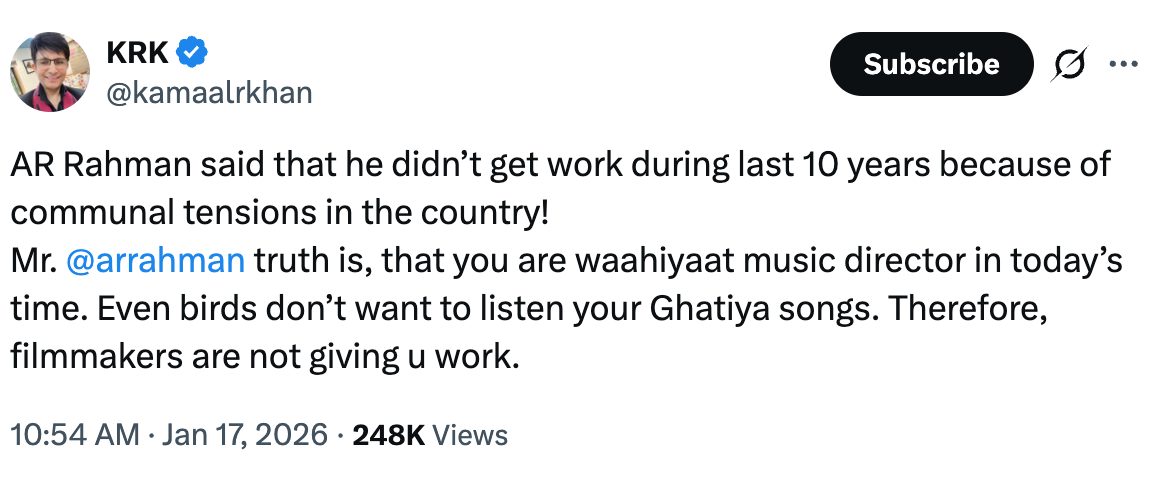
Whether or not one agrees with this subjective appraisal of Rahman’s music is beside the point. It only bolsters the underlying reason for the outrage against Rahman.
A.R. Rahman is the only music director in the history of Indian cinema to build an MNC-scale corporation with global reach: state-of-the-art studios, music education institutes and what he calls a “conservatory.” All of this, made possible by ordinary Indians — majority of them, Hindus — who paid to listen to his music and gave him unqualified affection.
His career graph clearly shows that by the mid-2000s, he had carefully nurtured a personality cult and an ecosystem of dependency. Musical aspirants got the message that working in his ecosystem was their surest ticket to great success in the shortest possible time. His image as a reclusive, quiet, hardworking and apolitical professional appears to be a deliberate build-up to his mystique.
However, there’s only so long that one can sustain a facade.
Until his ill-fated BBC interview, Rahman had carefully steered clear of what are known as “communal” topics. However, typical of the zeal of a new convert, he never missed an opportunity to extol the glories of his adopted faith.
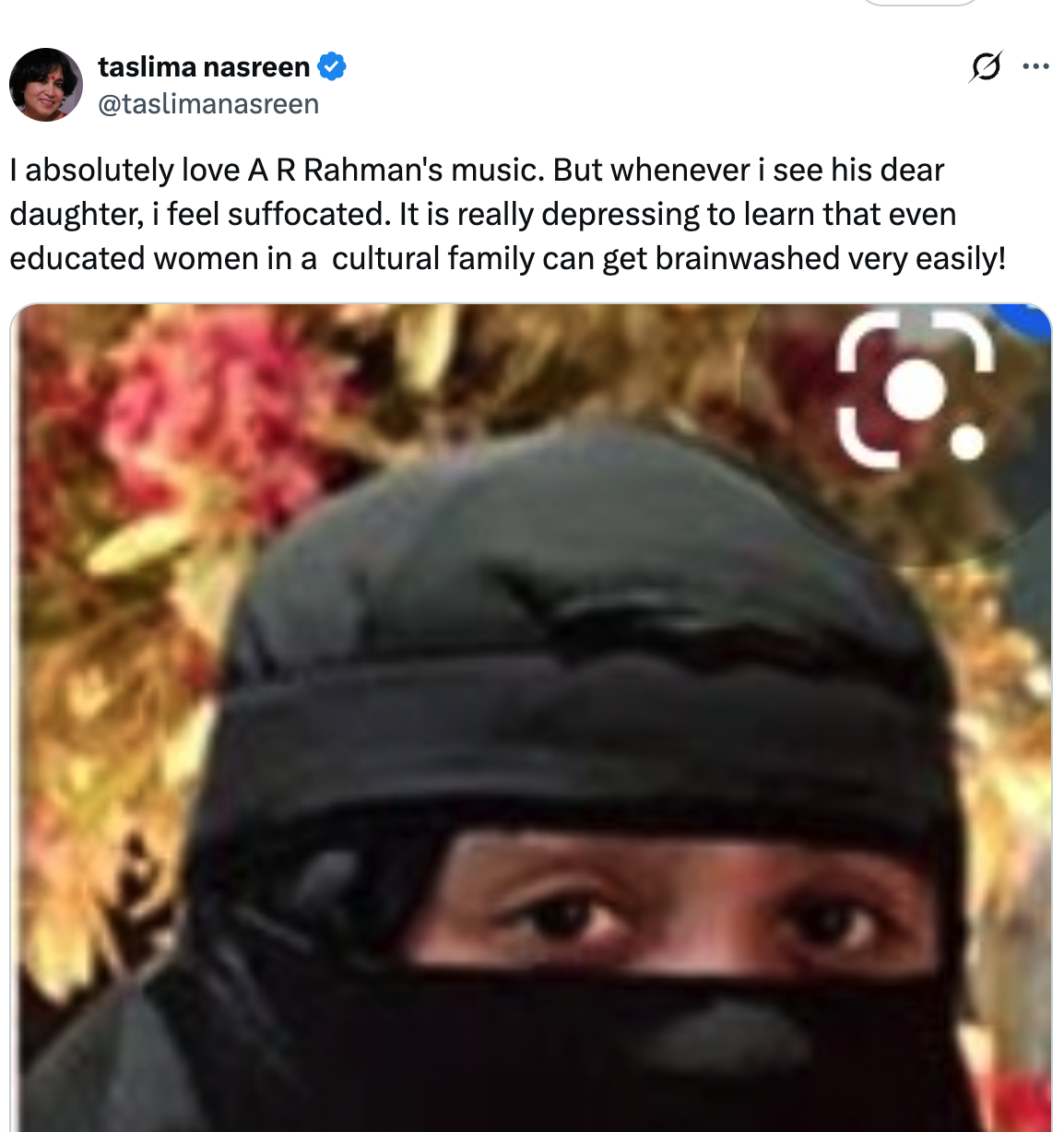
In a 2000 interview with Karan Thapar, Rahman admitted that he never liked his birth name, Dileep, because it “did not resonate with his self-image.” His biography, AR Rahman: The Spirit of Music, mentions how his mother added “Allah Rakha” to his name because it came to her in a dream. In his Oscar acceptance speech, he credited the achievement to Allah. In 2020, Taslima Nasrin condemned Rahman’s neo-convert zeal in her pointed tweet regarding Rahman’s daughter wearing the Burqa:
Rahman’s well-known and highly-publicised attachment to Sufism and the Ajmer Dargah is also a rather glaring case in point. The Dargah erected in honour of Moinuddin Chishti who betrayed Prithviraj Chauhan to Muhammad Ghori is a painful and lasting wound in the collective Hindu memory. That A.R. Rahman finds it his “spiritual sanctuary” only rubs salt and chilli on this wound. The last decade has witnessed Rahman going on a blitzkreig of Sufi concerts in Dubai, New York and other high-profile venues.
Just as he has created a booming musical empire, Rahman has also straddled many worlds effortlessly at the same time. An impossibly long list of awards, honours, and collaborations with the world of Western music has flooded his way — the Oscar, Grammy, Golden Globe, BAFTA, and a dinner invitation to perform at the Barak Obama White House… honorary doctorates from Berkelee Music College, Miami, Middlesex...collaborations with Michael Bolton, Mick Jagger and Dave Stewart… Anyone familiar with how and why these distinctions are bestowed will tell you that Rahman knows his politics really well.
It is precisely this politics that impelled him to suddenly detect “communalism” in Hindi cinema. He has now joined the proud league of Mohammad Azharuddin & Co who played the Muslim victim card despite getting unconditional love from the majority Hindus and building enormous personal fortunes upon that edifice.
A.R. Rahman’s belated clarification in the aftermath of the backlash fools none because there is no remorse but prevarication. Though unsurprising, it only reinforces the same phenomenon: of ambitious Hindus who willingly abandon their ancestral Dharma for a few pieces of Sufi silver.
Postscript
In light of A.R. Rahman’s mask falling off, one waits to see whether the makers of the upcoming Ramayan will rethink their decision of retaining him as music director. If they persist with him, it is an even darker blot than Rahman playing the victim card. It will be the contemporary equivalent of a common slur that medieval Islamic chroniclers heaped upon Hindus: infidels have no self-respect.
And oh! Music is haraam in Islam.


