Commentary
Stalin is Desperate. Joseph Vijay is an Incipient Chiranjeevi
A desperate Stalin faces a leadership vacuum and an unproven film star Vijay emerges as a challenger in Tamil Nadu’s most unpredictable election yet

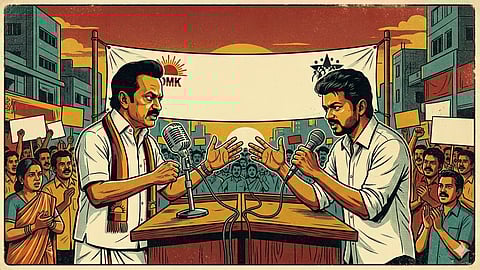

In Tamil Nadu’s highly unpredictable 2026 Assembly elections, Chief Minister M.K. Stalin is fighting a desperate battle for survival amid a deep leadership crisis in both DMK and AIADMK.
Compounding Stalin’s troubles is film star Joseph Vijay’s aggressive entry into politics with his party TVK, that lacks a clear ideology or strong organisation. He is loud and flashy but might suffer the fate of Chiranjeevi whose Praja Rajyam Party ended before it began.
As traditional Dravidian parties weaken and opportunistic alliances dominate, the election may signal whether Tamil Nadu is witnessing the twilight of Dravidian dominance.
OF ALL THE STATES poised for elections this year, Tamil Nadu presents the most bizarre case. Its own electoral history shows that this is like no other contest. The prevailing sentiment among professional psephologists is that it presents a phenomenon that defies almost every analysis. In more blunt terms, the scenario on the ground resembles a gossip-cauldron.
On another plane, these elections might well be history-altering.
The election in 2021 was the first in which both heavyweights — Jayalalitha and Karunanidhi — had exited the world. The consequent vacuum was almost tangible back then. But two things had won the day for the DMK — a sizeable amount of capillary waves of sympathy for Karunanidhi, and the implosion of the AIADMK in Jayalalitha’s absence. Even then, the margin of victory for the DMK in a substantial number of constituencies was rather feeble.
Against this backdrop, the 2026 polls is truly the first which is being fought in a climate of leadership drought in both the DMK and the AIADMK camps.
The incumbent Chief Minister M.K. Stalin never got a chance to grow under the banyan-tree leadership of his late father. Post Jayalalitha, the AIADMK’s never-ending saga of factions and defections reached a critical stage when former Chief Minister O. Paneerselvam defected to the DMK on 27 February, 2026.
The DMK’s situation reminds us of several pathetic episodes in Faulkner’s The Sound and the Fury, a macabre epic of the crumbling of a baronial lineage.
Since its second year in power, the DMK government has faced an unending typhoon of denunciation for wanton corruption, collapse of law and order and its flagrant targetting of Hindu Dharma. More alarmingly, in the post Covid years, several central and state agencies have uncovered global narcotics networks freely operating in Tamil Nadu.
More than anybody, M.K. Stalin is fully aware of the extent of unpopularity that his government faces. He has predictably resorted to desperate tactics like untrammelled Muslim appeasement and making a slew of reckless promises. His hopes of retaining power hinge chiefly on the captive Dravidian and Muslim vote bank and the hotchpotch alliance of 24 tiny parties most of which are caste-based. The Congress, which was first ousted in 1967, is not even a factor in the state.
KARUNANIDHI HAD LANGUISHED for more than a decade in the political wilderness during MGR’s regime but reemerged like a phoenix after the latter’s death. Stalin lacks the requisite skills, age, and the stomach for that kind of dogged fight. Besides, during Karunanidhi’s peak, the BJP was not the colossus that it is today. And so, Stalin, like the progeny of all patriarchs, is thoroughly ill-equipped to carry his father’s legacy.
At another level, the nature, tenor and vehicles of ideological and political discourse have transformed in ways that the DMK is yet to fully fathom. In all fairness, Stalin belongs to the last of the generation of politicians who were shaped by and in the era of Congress dominance. They manage to survive thanks to decades of being in power and building an ecosystem that sustains them. The April elections will tell us whether and how long the survival lasts.
THE DMK ALSO FACES a new challenge in the form of film actor Joseph Vijay who made his political ambitions clear in the 2011 elections when he supported Jayalalitha. Fifteen years later, with both Jayalalitha and Karunanidhi gone, he has forayed with undisguised aggression, committing shocking blunders in a highly public fashion. The Karur stampede in his September 2025 rally which killed 41 innocent people is the most grevious; what made it worse was his unapologetic behaviour in its wake.
The most puzzling aspect of Vijay’s entry is the absolute lack of any ideology or plank. No one knows what his party, the TVK, really stands for. Neither does his party have a well-defined organisational structure or notable second-rung leaders. He has expectedly steered clear of criticising Dravidianism and E.V. Ramaswamy Naicker.
And so, the most logical surmise is that Joseph Vijay belongs to that bevy of film actors who not only aspire to become politicians but want the Chief Minister’s seat in their maiden venture. Only two politicians achieved that feat — M.G. Ramachandran and N.T. Rama Rao. Both achieved it for different but closely related reasons.
MGR was a rebel DMK who was expelled from the party for exposing its dirty secrets and eventually got his revenge. It was more a moral and less a political decision to form the AIADMK. In terms of sheer popularity as a film star, MGR still stands unrivalled.
NTR plunged himself in politics with a solitary aim: to dislodge the Congress from undivided Andhra. The news of Anjaiah — a sitting Chief Minister — carrying Rajiv Gandhi’s footwear in the airport in full public view sealed NTR’s decision. He framed his rhetoric plainly: reclaiming the self-respect of the Telugu people from Congress imperialism. NTR’s popularity in Andhra exceeded that of MGR’s in Tamil Nadu — he was regarded as the very incarnation of Krishna.
Joseph Vijay clearly does not command that level of adulation; the Tamil Nadu of 2026 is not the Tamil Nadu of 1977. But if comparisons must be made, both MGR and NTR were knowledgeable and self-made leaders; they acquired their knowledge through a combination of native instinct, hard professional training, personal interaction with society, and life experience. More importantly, they were the only two film actors who became Chief Ministers. Vijaykanth and Chiranjeevi who enjoyed widespread popularity, failed in politics miserably.
Unpredictable as politics is, Joseph Vijay might emerge as a dark horse; his voter base almost exclusively comprises the legions of his diehard fans who hail from the lower strata in the general age bracket of 18 - 30; they are chiefly notable for public displays of unhinged crudeness not to mention their ganja addiction and joblessness. Additionally, some powerful sections of the Christian community have expressed their support, implying their shift away from the DMK. Whether this combination alone will ease him into the CM’s chair remains to be seen. If it doesn’t, he will be remembered as the Tamil version of Chiranjeevi who merged his party (Praja Rajyam) with the Congress in just three years.
The BJP faces the toughest battle given its open opposition to the Dravidian ideology. Even worse is the decades’ long stigma of being labelled as a party of Brahmins (derogatorily called Paarpanars) and North Indian “Aryans” that plagues it. On the ideological front, it has made impressive dents in the DMK’s Dravidian fortress but transforming it into power is still an uphill duel.
Overall, the chief strategy employed by these parties is sabotage, poaching and division. One really doesn’t know who is on whose side. But the outcome will tell us whether this election was indeed history-altering or a damp squib.
The Dharma Dispatch is now available on Telegram! For original and insightful narratives on Indian Culture and History, subscribe to us on Telegram.
