Commentary
The Calming Strength of his Palm
A tribute to the late S.R. Ramaswamy, a national treasure who passed away yesterday

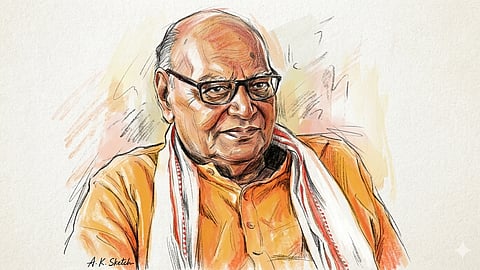

SONDEKOPPA RAMACHANDRA SASTRI RAMASWAMY departed yesterday just as he had lived. With serenity. In peace. And left behind a chasm that can never be filled. Writing about him in the past tense feels surreal for he endures as a profound Presence.
At 88, his mind was still as sharp as it had been when he was in his prime but for the fact that age had taken its toll on his body. He had characteristically submitted his column for the Kannada monthly Utthana days before the Final Call came. He had been indisposed for a few months, largely confined to his home but found time and energy to welcome guests, mentees, friends and visitors of every stripe and spent happy times with them. His abiding passion for writing made him polish off the final draft of an upcoming volume dealing with historical topics; he was also consuming thrillers and pulp fiction with equal verve. On occasion, he would complain that he had to “ration his vision” but everyone who knew him knew that it was half-a-ruse because he would reel off his informed analyses on some column that appeared in the latest issue of a magazine or newspaper.
S.R. Ramaswamy (fondly, SRR) is a rare cultural phenomenon that defies categorisation. In that and several senses, he was the exact successor to and inheritor of his Guru, DVG’s legacy.
Like DVG, he became known primarily as a journalist and editor, an institution-builder and a tireless champion of uncountable public-spirited causes. But journalism was simply how he earned his livelihood; those who have known him intimately do not constrain his his life-work merely to journalism. Doing so is akin to honouring Arthur Conan Doyle only for his services to the medical field. Oh, Doyle was among the top favourites of SRR. In a memorable conversation dissecting Sherlock Holmes, SRR nonchalantly cited the names of at least five authoritative sources of scholarship about the mythical detective. This felicity was natural; there was nary a sign to show off or impress. SRR was not merely a fount of knowledge and insight, he was a flood — except that one had to learn the fine art of opening the dam gates that he always kept tightly shut.
SRR’s embracive eminence can be attributed to the simple but grand definition of Yoga in the Bhagavad Gita: Yogah karmasu kaushalam — Yoga is expertise in one’s Karma. Be it his early days in the WQ Judge Press, his lifelong stint as a journalist and his brief forays into activism and photography, expertise distinguished him from the passionate second-raters. And like a true Karma Yogi, he neither aspired nor cared for the fruit of his Karma. When accolades and awards sought him, he accepted them with his patented staid expression.
As I’ve observed in some detail elsewhere, SRR has not received the full recognition that his stature merits.
Nowhere is this truer than in journalism.
SRR joined the profession in the mid-1950s and eventually served as the chief editor of Utthana for nearly five decades; in the last four or five years, he remained in the position in an honorary capacity. Notwithstanding the numerous awards for journalism that SRR received, one awaits a sober body of work that explores the full and nuanced value of his journalistic ouvre. Like his illustrious Guru DVG, SRR too, imbued timely writing with a timeless quality. Several of his junior contemporaries went on to build lucrative media empires but SRR stuck to old-fashioned methods and ideals armed with a modest collection of fountain pens, a writing pad and unimpeachable integrity.
SRR’s profession naturally gave him close access to an impressive gamut of acquaintances in power centres. He served as a quasi policy advisor to former Chief Minister Devaraja Urs and wrote several of his speeches; he also shared a cordial relationship with former Prime Minister Deve Gowda. He was also friends with high-ranking civil servants and judges of various courts including the Supreme Court. All of these sat lightly on his shoulders.
Few journalists have been so thickly in the scene and at every step on the thresholds of momentous changes that engulfed India especially after Rajiv Gandhi’s death. SRR’s Shatamanada Tiruvinalli Bharata (India at the Turn of the New Century), Swadeshi Jagruti (Awakening of Indigenisation), Swadeshi: Ondu Samvada (Indigenisation: A Conversation), Bharatadalli Samajakarya (Social Work in India, which he edited), Arthikatheya Eradu Dhruva (Two Poles of Economics) and In The Woods of Globalisation are truly original expositions on these complex issues; they belong in the realm of classics but have sadly fallen into neglect.
S.R. RAMASWAMY’s greatest accomplishment was rescuing DVG from being buried under the debris of obscurity like most of his other distinguished contemporaries. A grandson of DVG has admitted to this in so many words; that the credit for keeping alive DVG’s life, stature and legacy fully belongs to SRR and his friends.
A big marker of the enduring impact of this rescue mission began showing itself over the last decade.
Around seven or eight years ago, there was a spurt of initiatives related to rediscovering DVG by the Internet generation. Ever since, it has become a full-blown explosion, motivated mainly by commercial interests. Without sounding uncharitable, such initiatives encompass a wide span — from the average to downright crass with little inbetween. The last public celebration of DVG occurred in 1987, marking his centenary. For the next three decades, DVG had largely faded away except for stray reproductions, commentaries and renditions of Mankutimmana Kagga. In this bleak interim, it was SRR and other DVG devotees who noiselessly kept his legacy alive.
A central effort in this endeavour involved saving and sustaining the concrete structure of DVG’s legacy — the Gokhale Institute of Public Affairs (GIPA), Bangalore.
Founded in 1949 by DVG himself, it ran into inclement weather after his death. By the end of the millennium, it had become a dreadful mess thanks to two decades of management via negligence. Although SRR was DVG’s direct disciple and was associated with the Institute since about 1954, he had little say in it under new dispensations. Yet he doggedly persisted and nursed it back to health with the assistance of likeminded souls. It has not only been revived on a profound scale but functions largely along the ideals that DVG espoused.
GIPA is also where I first saw SRR more than twenty years ago. He was seated in the cosy anteroom adjoining the spacious lecture hall, hunched over a modest wooden desk writing something. I had no way of knowing that he ran the whole place. He was at the same place every evening as I attended various lectures delivered by Shatavadhani Dr. Ganesh. A month or so later, my good friend Vasuki sated my unspoken curiosity when he pointed to SRR and said, “Who’s he? He’s the real Boss, maams, come, I’ll introduce him.”
Three or four years later, the late Dr. N.S. Rajaram kindly invited me to be a part of informal conversations that took place every Saturday morning at Rashtrotthana Parishad in SRR’s modest Editor’s chamber. I was told that these sessions had a history of at least three-plus decades. This weekly conclave reminds me of an age-old, unbroken social tradition that is patently Indian — of rural folks seated around a stone platform underneath an ageless Pipal tree and exchanging the tidings of the world and gossiping with abandon and occasionally dropping pearls of insight all the while consuming snacks. In our case, it was mostly Rava vada and sweets and tea, whose divine brew SRR failed to patent. It was our private parliament where time stood still, sans recess or Question Hour; it was also our university sans classes. Unimaginatively called Baitak, it was memorably renamed about three years ago as Anubhava Mantapa by Sri Babu Krishnamurthy, the accomplished Kannada writer. SRR was its cynosure and its magnet. His failing health compelled its closure last November. It will endure as one of my fondest possessions. I don’t think I have courage enough to even look at that chamber bereft of SRR. It reminds me of a haunting scene in Waugh’s Brideshead Revisited:
It is a need that will never be fulfilled because a vacuum has replaced it. My dear friend Kashyap Naik’s quip encapsulated the sentiment best: there is no one to fall back upon now. That phrase could well be a refrain in a dirge mourning SRR’s passage.
Those who have savoured SRR’s company even for the briefest time will come away with the regret that they should’ve met him decades ago. To borrow Emerson’s eulogy of Thoreau, “he met his companions on the simplest terms.” In SRR’s case, he met rank strangers on the same terms. In crowds and functions, he was the least conspicious; in personal conversations, he was a Presence whether he spoke or stayed silent. He willingly gave the best parts of himself to every person regardless of their age — the value and the ideal that that person brought to the table was his sole criterion. He went out of his way to encourage, help and mentor genuine workers in the area that was dearest to his heart — Bharatiyata. In fact, there is an entire army of people who have benefitted from his guidance. He had an uncanny knack for spotting such promising talent and unbeknownst them, they would be the recipients of his magnanimity and assistance. A more detailed account of his selfless service in this regard is available elsewhere.
Even so, SRR was the least judgemental person that I’ve ever met; his capacity to allow great latitude to Herculean phonies, professional pretenders and ignorant loudmouths borders on disbelief. Yet, he could be unsparing with people who tried to injure his deepest convictions; SRR never confounded diplomacy with honour because he had put himself beyond the reach of material vagaries. In plain words, he had nothing to lose.
SRR derived his strength of character from profound reservoirs. His family background was rooted in spirituality and traditional learning; he spent most of his youth in the company of giants — DVG, Motaganahalli Subrahmanya Sastri, A.R. Krishna Sastri, Rallapalli Anantakrishna Sharma, S. Srikanta Sastri, Masti Venkatesha Iyengar et al. In his heartfelt profiles of these men, we also detect the partial story of his own evolution.
SRR, like DVG, lived like a Virakta — a renunciate. Nothing illustrates this spirit better than this earnest verse from Mankutimmana Kagga:
horage lokāsaktiyoḻage sakala virakti ।
horage kāryadhyānavoḻagudāsīna ॥
horage saṃskṛtibhāravoḻagadara tātsāra ।
varayogamārgavidu - mankutimma ॥
On the outside, we must engage in every worldly activity. Inside, we should practice detachment from it. On the outside, we must give ourselves fully to the work at hand. Inside, we must be indifferent to its result. On the outside, we must take part in cultural endeavours. Inside, we should be aloof from it. This is the path of Yoga - Mankutimma
We observe the practical implication of this verse in SRR’s life. To put it mildly, there is a staggering body of work striding multiple domains endowed with SRR’s selfless labour — essays, books, reports, speeches and activist work — which do not even mention his name. His contributions in these areas went beyond and above his professional duties as an editor and journalist. He never asked to be acknowledged much less raised criticism when they appeared in public light bearing the shameless authorship of pious frauds. When questioned about his telling silence, he dismissed it with a casual wave of his palm indicating that such fights were akin to elegant trifles worth nothing.
SRR maintained this stoic attitude towards life and work throughout. A series of ailments battered his body over the last seven or eight years and he bore them all without complaint. He was unfailingly present in the Anubhava Mantapa sessions; none of us had the hint of the extent of his suffering until some time. A pleasant sibling of these sessions was the periodic excursions to second-hand bookshops that he took us to and treated us to a hearty meal at Ballal Residency — none dared pay the bill.
Yet, SRR was among the most sentimental men I’ve encountered. He would uninhibitedly, copiously weep on stage at the recollection of a painful memory — say, the passing of DVG or Swami Satchidanandendra Saraswati.
THE LIVES OF DVG and SRR are akin to mirrors. The similarity tends to sameness. SRR was exactly half a century younger than DVG. SRR merged in eternity half a century after DVG. We observe DVG’s model in SRR but not its imitation. The points of difference, the angularities of character and divergence of tastes between the two were significantly different. This is a point worth a detailed and independent exploration.
DVG was averse to technology — for instance, he was deeply suspicious of the tape recorder and despised cinema; SRR knew how to assign technology its rightful place and watched all kinds of masala movies and regularly tuned into vintage BBC and VOA broadcasts; he was also an avid photographer for some years. DVG kept pulp fiction and crime novels far away from him; SRR relished them with abandon.
DVG passed away in the aftermath of the Emergency; I suspect, as a dismayed man who had experienced the hardships of the freedom struggle only to see it bartered away for homegrown dictatorship. SRR passed when the forces that had inflicted the Emergency have largely been rendered impotent — he played no small part in offering the ideological resistance needed to defeat those forces.
Which evokes the same lament: S.R. Ramaswamy has not received due recognition, and by recognition, I do not mean an award of some hue but as a national treasure.
SRR’s final wish was to publish the complete English writings and letters of DVG — in itself, a daunting task. With his characteristic tenacity, he finished it in about eight years teaming up with B.N. Shashi Kiran. Its publication completed the circle of DVG’s bequest that SRR had undertaken to preserve. One suspects that SRR had held on to dear life in his final years to witness its fruition.
S.R. Ramaswamy was a solace, a succour, a Wise Elder, a matchless repository of anecdotes, a true Renaissance Man, a friend who transcended generations and a father figure. Above all, he embodied the finest traits of a Sthithaprajna.
Perhaps the best way to estimate a mentor is not through nostalgia and memories but through preserving insights that emerge in casual banter; memories are ephemeral, insights, ennobling and permanent.
What I miss most is the feel of the calming strength of his palm on my back when I touched his feet. It was the blessing of the Eons.
How does one bring him back?
|| Om Shanti Shanti Shantih ||
The Dharma Dispatch is now available on Telegram! For original and insightful narratives on Indian Culture and History, subscribe to us on Telegram.
