Notes On Culture
Mahakavi Srinatha Throws a Challenge to Arunagirinatha Kavi
Nori Narasimha Sastry fleshes out Mahakavi Srinatha's character as a feisty and talented poet who throws a deceptive poetic challenge to his counterpart, Arunagirinatha

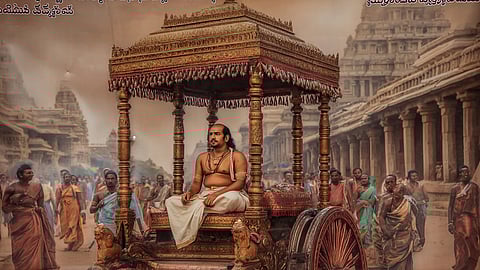

In his historical novel Kavisārvabhaumuḍu, polymath Nori Narasimha Sastry leverages meticulous research to dramatize a high-stakes 15th-century intellectual conflict within the Vijayanagara Empire. The narrative centers on the rivalry between Srinatha Kavi, the court poet of the Kondaveedu principality, and Arunagirinatha Dindima Bhatta, the formidable but arrogant Education Minister (Vidyādhikāri) of King Devaraya II.
WHEN WE READ Nori Narasimha Sastry’s essays, it becomes evident that he was well acquainted with numerous subjects such as music, dance, sculpture, painting, and other subjects.
One striking feature in his novels is that most of the characters — major or minor — are depicted in a thoroughly historical manner without any distinction. This is evidence of his meticulous historical research. In his time (about sixty years ago), information was not as abundant or as widely accessible as they are today. How he managed to achieve such profound scholarship while living in a small town like Repalle remains astonishing even today.
Kavisārvabhaumuḍu is a compact novel. Its period is the fifteenth century. The events of the story span from the Pushya month to Ashwayuja month — roughly nine months. In all his novels, the duration of the plot is rather short; yet within this brief time span, numerous events unfold, and the narrative becomes highly engaging — yet believable —with many twists. This is beautiful testimony to his storytelling technique and skill in plot construction. Similarly, within this period, he tightly incorporates all the prior and subsequent background details and context required for the plot so that it fits right into the present narrative.
THE PERIOD WHEN DEVARAYA II (Proudha Devaraya) was king marked the glory and zenith of the Vijayanagara Empire. He was a great warrior, astute in statecraft, and a patron of arts. In his court were poets hailing from different languages. From the time of Vidyaranya Swami and Sayanacharya onwards, Vijayanagara had become the principal seat of attraction for poets and scholars from all over India; among those who came here from various regions were scholars from Vanga or Gauda Desha. One such scholar and poet was Śōṇādrinātha.
The bronze gong that Bukkaraya had respectfully presented to him became the emblem of scholarship for him and scholar-poets of his lineage. A descendant named Arunagirinatha Dindima Bhatta, held the position of Vidyādhikāri (education minister, in today’s parlance) in the court of Devaraya II. He was also a poet. Wherever he traveled, he would proudly carry and ring that gong, with the self-assuredness that he was a great scholar-poet. This candid display of pride was quite insulting to other poets and scholars. Some among them would step forward wanting to defeat him in debate and humble his arrogance. But because Arunagirinatha would effortlessly defeat them in debate, there was no end to the muted suffering of all these poets and scholars.
In the neighboring Andhra region of Vijayanagara, on the banks of the Krishna River, there were two principalities: Kondaveedu and Rachakonda. The capitals of these two kingdoms — belonging to warring dynasties — were situated on facing hills, visible to each other. Their rulers were descendants of Malla Reddy and his compatriots who had fought against the Muslims. Due to internal conflicts, their kingdoms had declined and gone their separate ways. Though there was mutual enmity, the kings of both these regions possessed admirable pride in recognizing the abilities of poets, sculptors, and artists in their respective territories, and in ensuring that these artistic skills flourished better in their own domains than in the rival’s. Cultural competition, rather than political rivalry, formed the backdrop.
SRINATHA KAVI was the court poet in the Kondaveedu principality. The Maharaja there was Vema Reddi. Even though his kingdom did not possess abundant resources, he and his dependents supported Srinatha quite handsomely.
By then, Vijayanagara had grown powerful enough to bring both these principalities under its control. Vema Reddi, who had hoped to demonstrate his political prowess against the mighty Vijayanagara, realised that he was powerless to do so. And so, he aspired to achieve literary victory in its stead.
Spurred by this ambition, he urged and encouraged his court poet and Vidyādhikāri, Srinatha Kavi, to defeat Arunagirinatha, the Vidyādhikāri of Vijayanagara, in debate. Srinatha, weary of family succession disputes and having no other ambitions, felt that fulfilling the wish of his elderly king — who had provided him with every convenience —would help him discharge the debt of gratitude he owed. It is truly praiseworthy that even as a man who enjoyed worldly pleasures with abandon, Srinatha was imbued with a high sense of values. Thus, setting out for this momentous task, Srinatha gathered a group of poets and scholars and proceeded to Vijayanagara.
He stayed in that great city and understood its pulse. But a pretext was needed to provoke a debate with Arunagirinatha. After all, there is no debate without a dispute. Else, engaging in a futile argument would lead to a loss of reputation. Thus, Srinatha’s objective was to create a dispute that would culminate in his victory.
Towards this end, he composed a narrative Sanskrit poem (Khanda-Kavya) titled Mānasōllāsa, which included descriptions of Vijayanagara, the life of its people, and the shrine of Pampa Virupaksha. It must be mentioned that there is no evidence to show that Srinatha composed any such poem. It appears that this work is the result of Nori’s imagination. However, it does not violate recorded history or the narrative of the novel. On the contrary, it is a welcome innovation.
Srinatha sent this work to Arunagirinatha through a grammar scholar from his own team named Nrsimha Bhatta, with a message: "Since you are the education minister of this empire, we seek your invaluable opinion on this work; we place our trust in your scholarship and aesthetic sensibility."
Arunagirinatha, who already knew that a scholar from Andhra had come determined to debate him, had resolved to crush him with his aggressive style of argumentation. However, the elderly Dindima Bhatta (60+ years) was about twenty years older than the middle-aged Srinatha (40+ years). Consequently, his memory and quick-wittedness had declined to some extent. Srinatha had factored this into his strategy.
At the appointed time, Nrsimha Bhatta went to Arunagirinatha’s house and read the poem aloud to him. In that poem, Srinatha had employed a literary trick called apaśabdābhāsa (the illusion of ungrammaticality). The verses, which appeared to have grammatical errors on the surface, were actually structurally sound.
Failing to notice this nuance, Arunagirinatha declared the poem to be full of errors. Srinatha, who was waiting for this precise moment, sent a letter of protest: "It is unjust and improper of you to call the work of a good poet like me as erroneous in the presence of a great grammarian (Nrsimhabhatta). You must apologize to me for this. As part of your apology, you must surrender to me the bronze drum that has come to you through your lineage." Arunagirinatha, refusing to yield, rejected the demand in anger.
Then Srinatha sent his second letter of protest: "If you do not admit the mistake born of your obstinacy and surrender your bronze drum to me by the full moon of Vaishakha, I will have drums made of bronze, silver, and gold, and proclaim myself as the ‘Emperor of Poets' (Kavi Sarvabhauma) by parading throughout the city of Vijayanagara."
Arunagirinatha ignored this as well.
Srinatha then had several copies of that letter made and sent them to the King and other prominent figures. Furthermore, as he had previously stated, he had the three drums made and conducted a grand procession for himself throughout Vijayanagara. While all this turmoil was unfolding, Arunagirinatha’s eldest son, Rajanatha, was not in the city. He had gone to agraharas allotted to his lineage for grain collection and arrived while the procession was happening.
But before leaving for the grain collection, he had warned his father: "A scholarly poet named Srinatha has arrived here from Kondaveedu. He seems to be plotting some scheme to defeat you. You are prone to haste and ego. If you act rashly without thinking properly, you will land in trouble."
And things had occurred exactly as he had predicted. The father had neglected his son's warning and the situation had reached this point. And now, when Rajanatha grasped his father's folly, he read the poem himself and said, "Alas, is this not the apaśabdābhāsa trick? How could you not spot it? How did you commit such an error publicly? What is to be done?"
And so, now, the father’s intent was that if he could not win through grammar, he would win through poetics (Alankara Sastra). For grammar, the three sages — Panini, Vararuchi, and Patanjali — are the ultimate authorities. But poetics was different. There are no such precise authorities there; the standard of aesthetic sensibility can be interpreted using the yardstick of connoisseurial delight, thereby providing an escape route. This is generally well known to all scholars.
To be continued
The Dharma Dispatch is now available on Telegram! For original and insightful narratives on Indian Culture and History, subscribe to us on Telegram.
