History Vignettes
Hyderabad was never an Independent State: History’s Verdict
Asaf Jah I's Will, the Nizam's Legal Position, and the Record of Misrule in Hyderabad

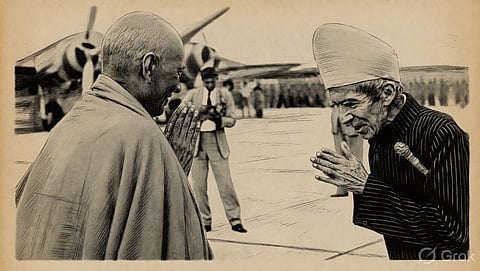

Discover Jadunath Sarkar's historical analysis of the Nizam of Haidarabad's legal status as a provincial governor and a critique of the administrative failures under the Asaf-Jahi dynasty.
ON SEPTEMBER 17, 1948, Sardar Vallabhbhai Patel decisively extinguished the moth-eaten state of Hyderabad in less than 48 hours. On The Dharma Dispatch, we’ve published several essays dissecting the alleged glory and splendour of this oppressive Muslim despotism in which 90 per cent of Hindus were in the thrall of a heartless Nizam.
After the British departed in 1947, Nizam Mir Osman Ali persisted in his obstinacy to remain “independent.” Even as Patel, K.M. Munshi, et al., were trying to shine the light of sobriety and common sense into the Nizam’s opaque psyche, public opinion was unambiguous: Osman Ali had to go.
Acharya Jadunath Sarkar was at the forefront of those who wanted this rabid “cancer in India’s belly” to be permanently eradicated. His Herculean status as India’s towering historian enabled him to detect in Hyderabad (then spelled as Haidarabad) what most people had failed to detect: that since its inception, Hyderabad had never been an independent state.
In a majestic essay in August 1948 — a month before Operation Polo — Jadunath Sarkar compressed a 224-year-old history in the space of about 1600 words. It was titled, From Asaf Jah I to Osman Ali. It remains one of the authoritative expositions on the subject.
Happy reading!
ASAF JAH, THE FIRST NIZAM i.e., governor of Haidarabad, left a will in which he solemnly charged his descendants,—
Firstly, to be always friendly with the Marathas "who are the owners of the land in this country,” and —
Secondly, never to put any human being to death without a judicial trial by an authorized judge. The portion of the will giving these orders is printed below from a photograph of the original preserved in the Nizam’s Government Record Office so that its authenticity cannot be questioned.
“Awal an ke rais-i-Dakhin ra lazim ke ba Marhatta ke zamindar-i-in mulk ast, ashti warzad.
Duyam an ke dar hadm-i-baniad-i-bani-Adam . . tamul kunad wa mujrim wajib-ul-qatl ra ba Qazi, ke hakim-i-shara ast, tafwiz numaid.”
Here it should be noted that the founder of this dynasty, to the very end of his life, called himself only a Rais or chieftain; and never a Shah or Sultan, in spite of his having won the victory at Shakarkheda (1724), which the present Nizam has been misrepresenting as the Day of his Independence!
In fact, so long as there was a Padshah at Delhi, the rulers of Haidarabad always sought the recognition of their succession from that Padshah or his keeper, because they were merely hereditary office-bearers under him. When Mahadji Sindhia was appointed by the Emperor Shah Alam II as his perpetual Regent, the then Nizam sent an agent to Sindhia’s camp near Delhi to secure such recognition through him. This is proved by the British Residency Records published by the Bombay Government.
Such was the Nizam’s legal position in 1785, sixty years after the so-called independence achieved at Shakarkheda.
In 1804 the British took over Delhi and the perpttual regency of the Padshah from Sindhia and became the master of the Nizam. In 1858, the shadow of a Delhi Padshah was abolished, and the English became fully sovereign over all the provinces of the Mughal Empire including Haidarabad.
In 1947 the English handed over Delhi to the Indian Union, and thus the Indian Union legally stepped into the position of the suzerain of the governors of Haidarabad. The Nizam cannot exist politically in vacuo.
It is also recorded in Persian histories that when in 1739 Nadir Shah entered Delhi as conqueror, he offered to place Asaf Jah I on the throne of Delhi, as he was disgusted with the folly and vices of the Emperor Muhammad Shah,— but Asaf Jah declined this independent sovereignty and declared his satisfaction with his present position of a provincial governor. The word Nizam comes from the same root as Nazim and means a governor, or king’s deputy.
But apart from legal controversies, the right of a family to rule ultimately depends upon the condition in which it keeps the mass of its subjects. Can the Asaf-Jahis stand this test?
In 1776, a French nobleman, Comte de Modave visited Haidarabad, and has thus recorded what he saw there of the condition of the people:
Les Musalmans triomphent dans cette ville qu’ils ont batie et ou ils sont les maitres — “The Nizam’s country had never been anything but a puppet State. The present Nizam was understood to be, in Malcolm’s phrase, ‘a melancholy madman.’”
“Never, to be sure, was there such a Government as that of Haidarabad since the world began, and what can be done to remedy its present state would baffle any politician.” [Edmonstone, Secretary to Governor-General to Resident at Haidarabad, 6th May, 1812.].
“The country soon became depopulated and necessities rose to famine prices. Government ceased. There was not a shadow of law or police anywhere; bands of armed plunderers traversed the roads and jungles.”
This was in 1820. Do the reports of 1948 give any better picture of the Nizam’s Government?
On 6th November, 1847, the Times of London wrote on ‘‘the moral and political right of myriads of the population to turn to the Governor-General for succour, protection and redress. . . The Governor-General’s easy task is to level those masses of misgovernment which obstruct the free circulation of prosperity and happiness throughout the peninsula (i.e., the Deccan), and to advance those improvements by which such blessings are so materially promoted… The Nizam is morally accountable to us.” (Quoted in Lee Warner’s Dalhousie, I, 97.)
Sir Charles Wood (President of the Board of Control) wrote to the Governor-General on 8th May, 1853, “What are you going to do with the Nizam? Everybody seems to suppose that he cannot administer his own affairs much longer.” (Lee Warner, II, 131.)
On 14th May, 1852, the Resident, General Fraser wrote to the Governor-General, “I cannot hesitate to repeat the opinion that the Nizam’s Government possesses but little capacity or vigour, and that if the Nizam be replaced in a position of honourable independence among the Native Princes of India, this will never be done otherwise than under temporary European management.” (Memoir, p. 373.)
Sir Richard Temple, who was Resident in 1867, writes,- “My main business was to secure the stability of His Highness’s realm by decent administration. That realm had several times been brought to the brink of destruction by misgovemment. In the present temper of the Nizam, these evils might but too easily recur.” (Story of My Life, I, 174). “The Arab soldiers had been imported to form a Pretorian Guard. But for Lord Dalhousie’s interposition in 1855, they would have imprisoned the Nizam in his own apartments… In 1857 ... they would have seized the sovereign power in the Deccan.” (Ibid, 179.)
W. S. Blunt who had the greatest sympathy with the Muslims and spoke Arabic freely, wrote during his visit to Haidarabad in December, 1883: “A teacher at the Moslem School told me, the Muhammadans here were far from happy. They were isolated and without knowledge of what happened in the outer world. We discussed the drinking of wine which is common among the Muhammadans of Haidarabad.” (India Under Ripon, pp. 68-69.)
1904 - “The inhabitants of Berar would have been dismayed at the prospect of reverting to Haidarabad rule.” (L. Fraser’s India Under Curzon, p. 225.)
In 1910, Mr. Casson Walker in his final report wrote, “There are not more than four or five roads in the interior of the Dominions, which are passable all the year. Owing to the lack of roads, and still more of bridges and culverts, the peasantry cannot market their spare produce in time of plenty, while when scarcity prevails, the absence of transport facilities leaves them at the mercy of the local money-lender.” (Ibid, p. 227).
Why was such abominable misrule and people’s misery allowed to continue during the century and a half when the Union Jack floated over the Residency at Haidarabad?
The answer is given by three English witnesses.
Russell, Resident with the Nizam, wrote in 1819: “If we owe the foundation of our empire in this country to the weakness in which we found the Native Powers, we ought not to complain of the evils which that weakness, necessarily produces. If we have reaped the benefits, we must submit to witness the inconveniences which are its inseparable attendants.”
W. S. Blunt supported this view 65 years later. He wrote from Haidarabad, “The policy [of the British] seems to be to keep the Haidarabad nobles in ignorance of modern thought, and it also looks as if the British Indian Government encourages the bad administration purposely.” (India Under Ripon, p. 68)
E. S. Montagu, Secretary of State wrote in 1918: “The Nizam is, of course, enormously important to us, because he has kept the Muhammadans of India straight, and we have used him; by means of his wily old ministers and our Resident, for this purpose.”
Montagu’s prediction has come true: “Really, this is ridiculous, and they are going to have trouble with this man [Sir Osman Ali, G.C.B.] by exalting him into a position of kingship.” (An Indian Diary, 213, 218.)
In December 1883, the Minister Laik Ali (later known as Salar Jang II) told Blunt that ‘‘he did not think that the ‘Nizam would be fit to govern the country by himself... But neither is the country fit for self-government.” (Ibid, p. 77).
Sixty-five years have passed since this political forecast was made, and today in 1948, another Laik Ali proclaims to the world that the people of the Haidarabad State are unfit for self-government! Will they be more fit under the present system and official gang, if we wait 65 years more, say in 2013 A.D.?
Sir Osman Ali has founded a Urdu University named after himself, among a population ninety per cent of whom cannot read or write Urdu. He spends lakhs of rupees on a translation bureau for making and printing Urdu translations of standard books in English. In a History of Europe issued by this department, the sentence “Luther burnt the Papal Bull” has been rendered in Urdu 'as Luther ne Papa-Rome ka byle ko jalai dia (Luther roasted the ox of the Pope of Rome). This information was given by a Muslim Professor of Aligarh to Dr. Rajendra Prasad at New Delhi on 24th Oct, 1946.
Such is the condition of education under the Nizam’s Government agency!
The Dharma Dispatch is now available on Telegram! For original and insightful narratives on Indian Culture and History, subscribe to us on Telegram.
