
![[PHOTOESSAY] A Bridge on the River Haridra](https://storage.ghost.io/c/7a/28/7a282001-d7d9-4557-89df-49e915555c31/content/images/size/w2000/format/webp/2026/06/Devarabelakere-Dam-Sketch.jpg)
Discover the hidden historical treasures of Devarabelakere near Davanagere. Explore the ruins of the 15th-century Haridra Dam built during Vijayanagara emperor Devaraya I’s reign and the neglected 1054 CE Kalleshwara Temple with its Chalukya-era inscription.
WHEN YOU TRAVEL from Bangalore on the fabled NH-4 (now NH-48) and touch the outskirts of Davanagere, you veer to the left to enter the service road and then again to the left to enter Shamanur. From there, a right turn leads you to a straight road that forks after about nine kilometres; when you take the left at the fork, you are in Devarabelakere, a quiet village typical of its thousands of cousins throughout Dakshinapatha. Typical for the intrinsic fate that it shares with these cousins: historical amnesia regarding its past eminence.
Exceeding a millennium and half, Devarabelakere enjoyed high status as an important civilisational and spiritual centre. History-altering and empire-shattering battles were fought in its vicinity. Jaina, Shaiva and Vaishnava saints and Gurus had set up their meditative retreats here. Not a trace of that remains today.
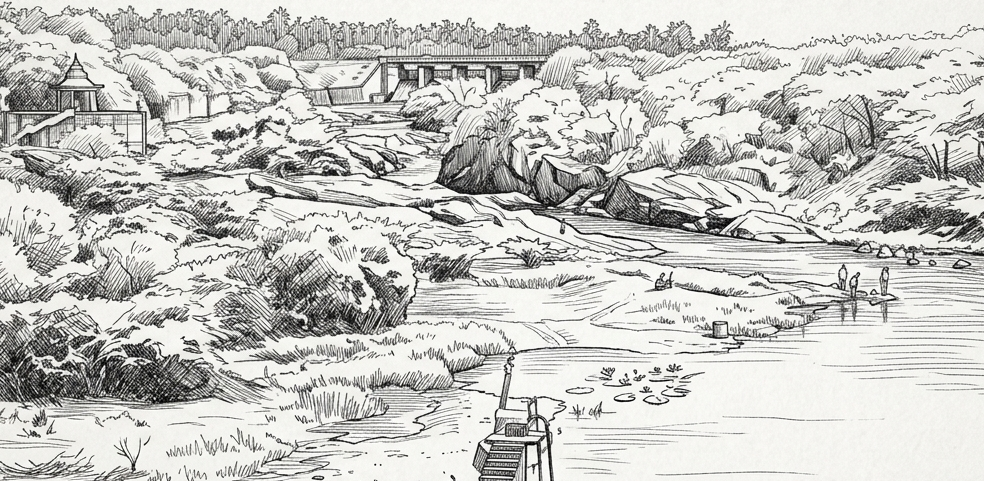
The last stop in Devarabelakere is the modest but impressive Mailaralingeshwaraswamy Mandira. A slight left before it leads you to a narrow and broken road, which after about 200 feet, culminates at the entrance of a dam that stretches for about a kilometre long. An enchanting vista of backwaters to your left welcomes you.
This is the Devarabelakere Check Dam (or pick up dam) and Reservoir constructed between 1978-86. To your right are the dam’s gates and a dilapidated structure that probably is meant for lifting and opening its gates. As you gaze farther ahead, you spot another dam, which is much shorter in both length and height.
This is the Haridra Dam originally built during the reign of the Vijayanagara monarch, Devaraya I. Its profound story has thankfully survived in inscriptions and is the reason that compelled me to visit it.
THE VIJAYANAGARA EMPIRE became extinct in 1565 CE.
In 1902, the Archeological Survey of India (ASI) discovered these inscriptions carelessly strewn about on the ground in the ramparts of the famous Harihareshwara Temple in Harihara, on the banks of the Tungabhadra. The original Haridra dam had long since been destroyed.
The discovery of these inscriptions spurred scholars and researchers to locate the exact spot of the original Haridra dam. Which takes us back to the aforementioned, picturesque Devarabelakere Check Dam.
When we exit the dam and turn right and head straight for about half a kilometre, we are on the threshold of the Haridra dam. Peering down, we spot a large ditch-like low-lying area, which archeologists have identified as the basin of the Haridra river, a tributary of the Tungabhadra. In a survey done in 2003, the scholar Dr. Jagadisha identified this spot as the place where the original Haridra dam had been built, pending newer findings.
AT THE EXIT of the Haridra dam, two pathways diverge downwards. The right tar road leads to the river’s basin; the left leads to a tiny slice of geography imbued with stunning antiquity. This “pathway” is a cramped, upraised muddy strip separating an arecanut and coconut farm to its left and a lush, expansive, green rice-field to the right.
After a kilometre of this gingerly journey, you spot a ruined stone Mandapam to your right facing the rice-field. It is neglected and orphaned, almost beseeching for help, which might never come.
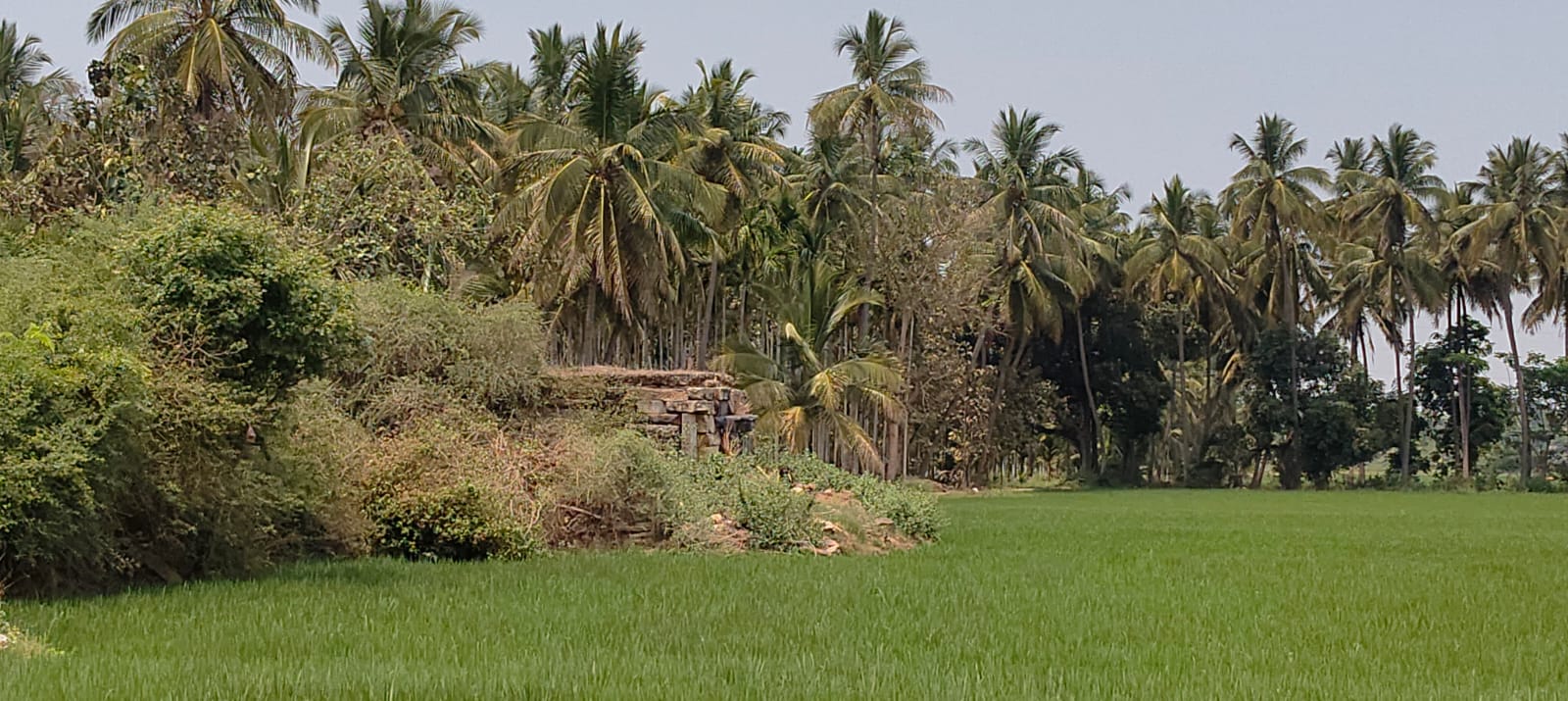
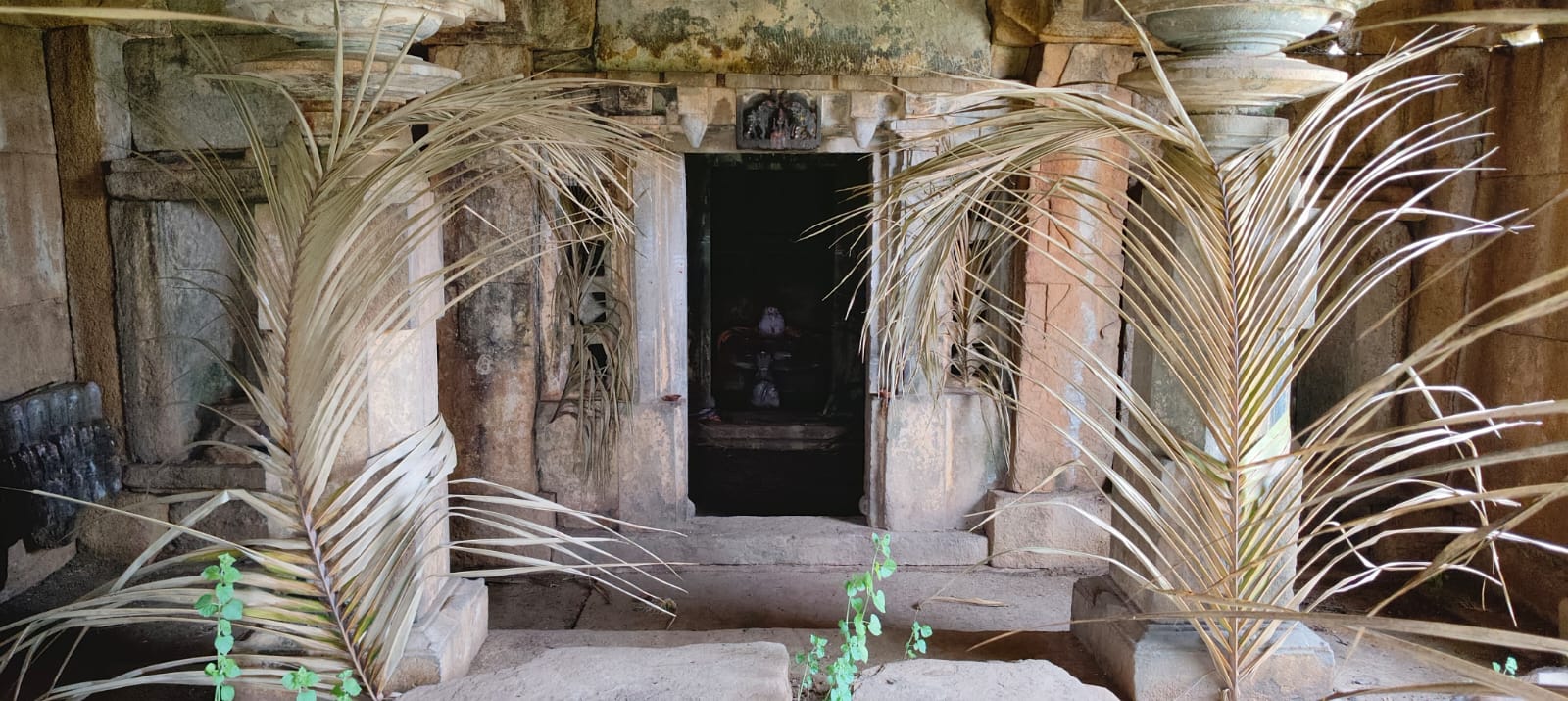
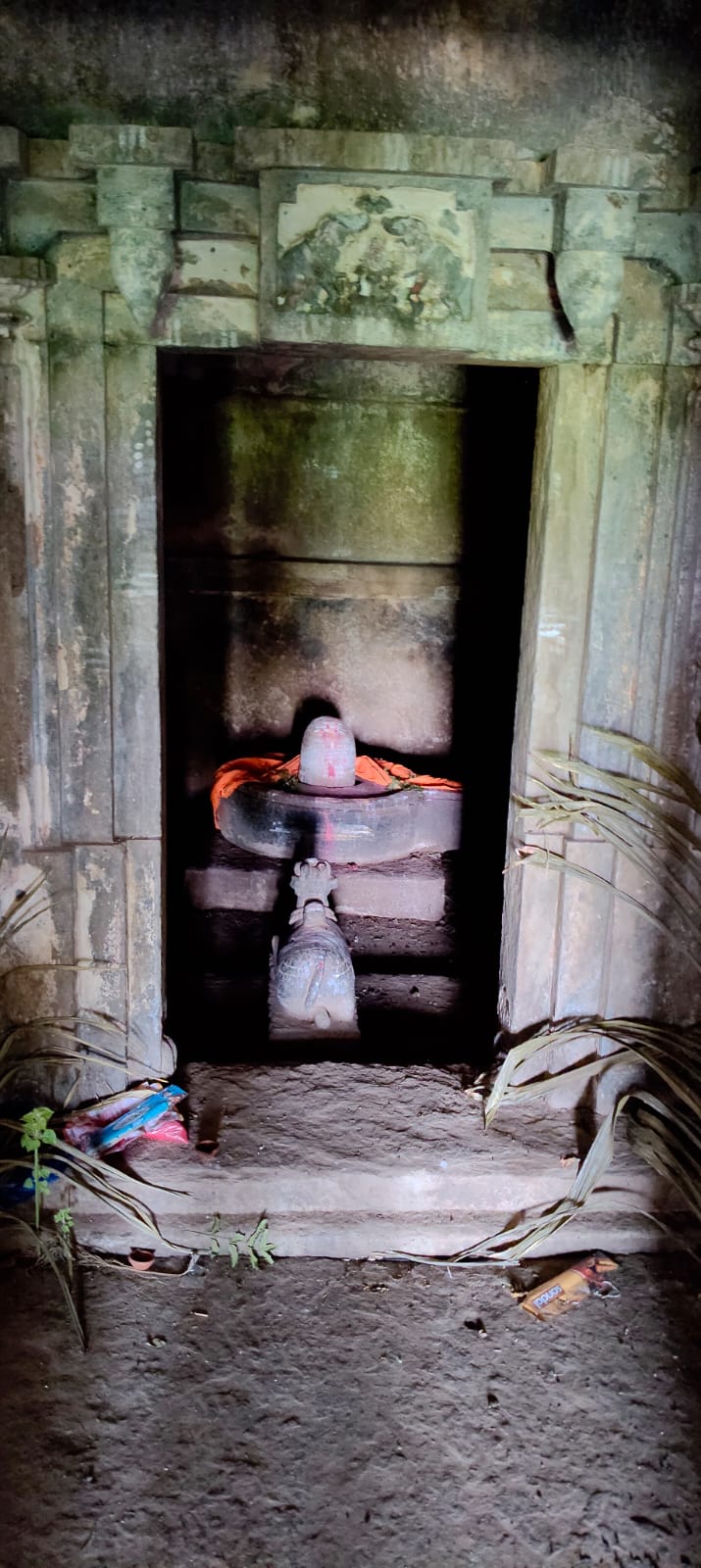
THIS IS THE KALI or the Kalleshwara Temple. Perched precariously on a mud-wrapped mound, it has no pathway leading to it. You need to climb up the mound and walk through shrubby thorns and hard earth. Inside, there is a pillared structure resembling a Rangamantapa. A journey of five steps ends in the Garbha-Griha where an artistic Shiva-Linga is being worshipped by a stray dog that sleeps behind it.
Mixed emotions surge inside you.
One of the synonymns of Bhagavan Rudra or Shiva is Shvapati or the Possessor of Dogs; in this sense, it is quite apt that this stray dog keeps his Lord company; humans have abandoned this Pashupati long ago.
And then you experience that templatesque melancholy when you visit such temples — the innards of this temple are literally coming apart before your own eyes; it might perhaps be a heap of stones the next time you visit it. But what compounds your woe is the fact that it was on a pillar inside this Rangamantapa that in 1902, the ASI discovered an inscription narrating its sacred glory. It now appears that all the writing on these pillars has been obliterated.
The date of the inscription is 1054 CE — in the regime of the Kalyana Chalukya monarch, Someshvara I. Its gist is typical of the piety and the spirit of generosity of the era.
The Kaliyuga Dhanvantari (the Deity of Ayurveda) named Vijayapandita granted land to a spiritual preceptor named Sovarāsi. The income from the land was to be used to offer Naivedya, Śāśvata dīpa (perpetual lamp), ghee, decorations and illuminations for the deity, Kali (the tenth avatara).
Clearly, this Kalleshwara Temple was originally a Kali temple but its traces are nowhere to be found. The Kalyana Chalukyas predated the Vijayanagara Empire by about 300 years.
The year of this inscription is immensely significant; it was in 1054 CE that the decisive Battle of Koppam occurred between Someshvara I and Rajadhiraja Chola I and Rajendra Chola II. The Cholas won but Rajadhiraja was killed in the battle and Somesvara managed to retain his territories.
WHEN YOU PROCEED from the Kalleshwara Temple, you reach another Shiva Temple to your left at a distance of about 300 feet enclosed inside a coconut grove. This too, is decripit and crumbling; this too, has a fine Shiva Linga but no dog guards it.
Both temples are situated along the left bank of the channel that flows from the original Haridra dam.
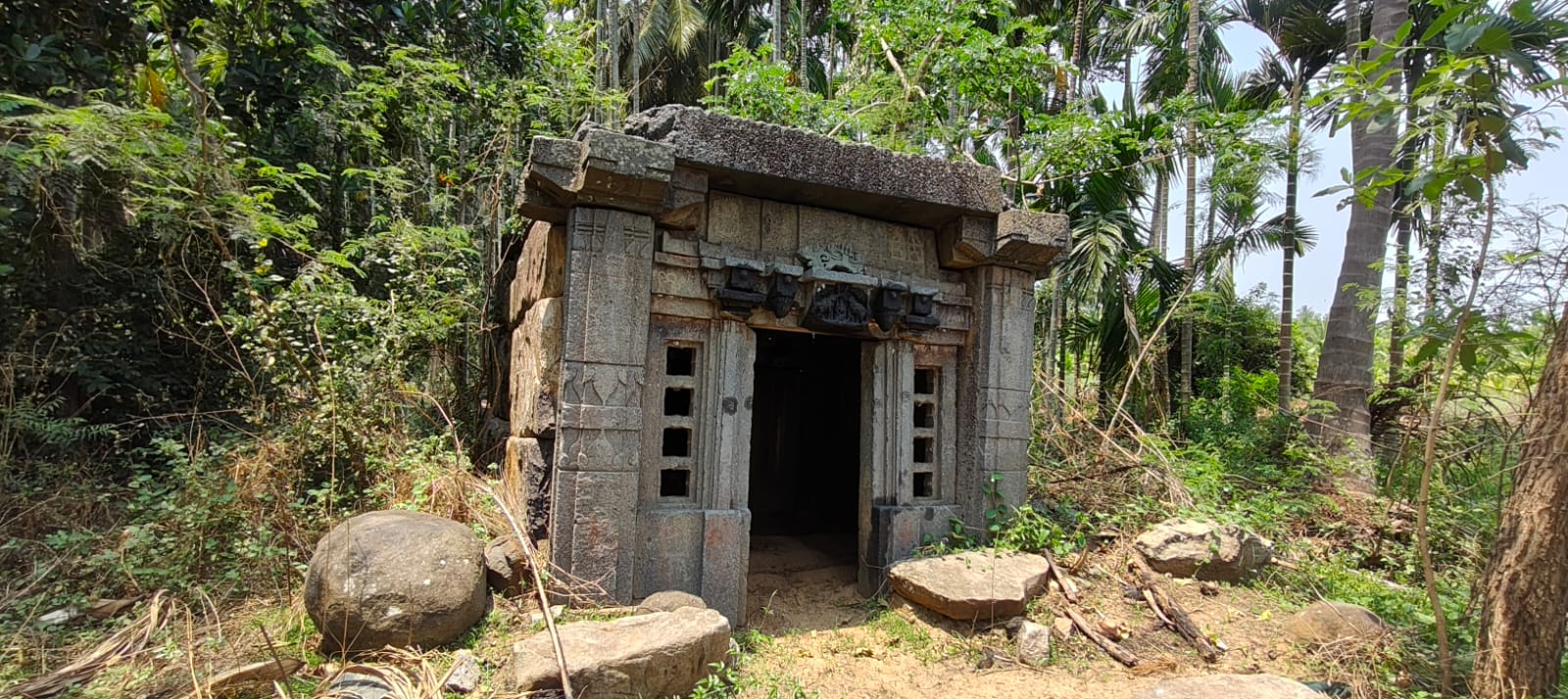
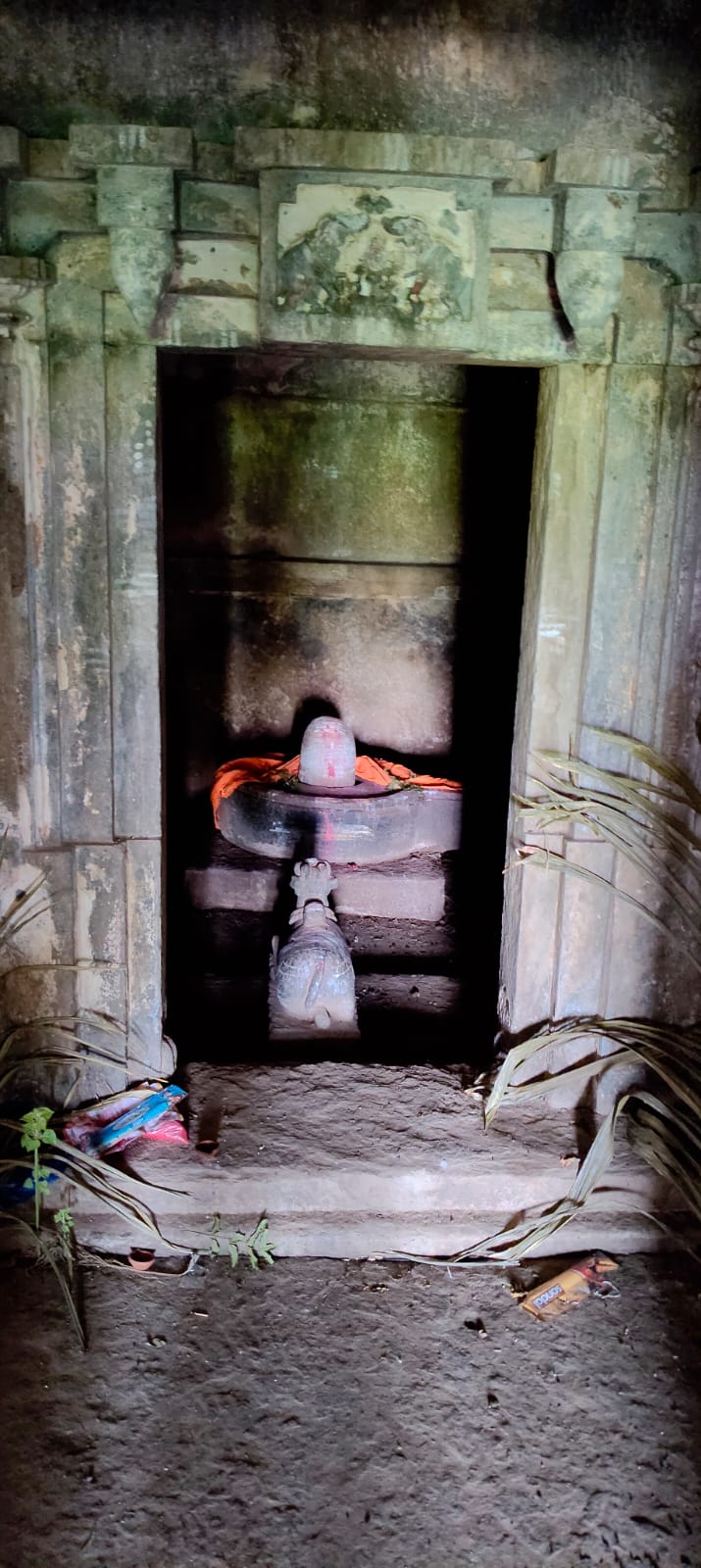
The whole experience is rather bleak and depressing against the backdrop of the evocative sentiment that had led to the construction of the original Haridra dam in the year 1410 CE. By a group of 108 public-spirited Brahmanas of Harihara.
That story will be narrated in the next episode of this series.
To be continued


