History Vignettes
Wellesley’s Grand Banquet in Lok Bhavan as a Symbol of British Plunder
On January 26, 1803, Wellesley throws a lavish dinner at Lok Bhavan, Calcutta, attended by Valentia. Its extravagance is funded by the British plunder of India.

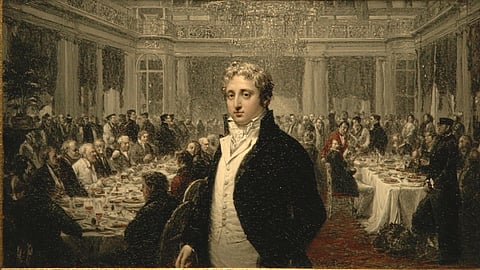

Marquis Wellesley's grand banquet held on 26 January, 1803 is a vulgar display of imperial opulence and hypocrisy, sustained by betrayal and exploitation of Indians.
JANUARY 26, 1803.
IN THE EARLY HOURS OF THE NIGHT, Viscount Valentia finds himself in the spanking new palatial Government House in Calcutta, now the Lok Bhavan of West Bengal.
Flushed with success after crushing Tipu Sultan, Wellesley in 1799 pompously announced that “India should be governed from a palace, not from a country house.” The “palace” was completed after four years at a cost of ₹ 13 Lakh and inaugurated on January 18, 1803, a week before Valentia set foot inside it.
His florid description of the building and its architectural intricacies and the grandeur of Wellesley’s stately dinner shows the extent to which it had dazzled him. To Valentia’s eyes, Wellesley was not just the Governor-General, but the undisputed monarch of India; his conduct too, reveals that he regarded himself as such. One of the triumphal trophies of his monarchy was a “Musnud of crimson and gold, formerly composing part of the ornaments of Tippoo Sultan's throne. On this was a rich chair and stool of state, for Lord Wellesley; on each side, three chairs for the members of council and judges.”
The grand banquet is also an exhibition of the class and status-conscious British society replicated on Indian soil. For centuries, the most definitive marker of status was encapsulated in the now forgotten chauvinistic phrase: know thy place! And here, in Wellesley’s new palace, nothing screamed out “status” as ostentatiously as the seating hierarchy for the elite European women. And it is the people hailing from such a compartmentalised society that disparaged our Varna system as unjust and oppressive.
After Wellesley delivers his welcome speech at 10 P.M., the ballroom dancing — another ubiquitous accomplice of elite European social intercourse — commences. Valentia’s description of the spectacle is quite illustrative.
The dancing then commenced, and continued till supper. The room was not sufficiently lighted up, yet still the effect was beautiful. The row of chunam pillars…were of a shining white, that gave a contrast to the different dresses of the company…Many of the European ladies were also richly ornamented with jewels. The black dress of the male Armenians was pleasing from the variety; and the costly, though unbecoming, habits of their females, together with the appearance of officers, nabobs, Persians, and natives, resembled a masquerade…the costume violated by no one. About 800 people were present, who found sufficient room at supper, in the marble hall below, thence they were summoned about one o'clock…
The scene is a sliver of the inestimable extravagance enjoyed by the upper-class British in India funded by betrayal, plunder and conscience-free exploitation of Indians. Valentia’s telling note about richly ornamented European ladies and their “unbecoming habits” has two corroborative echoes; one from the past, the other from the future.
The first comes from Calcutta. In August 1781, Nabakrishna Deb, the founding Maharaja of the Sovabazar Raj, throws a nautch party and “magnificent entertainment” in his palace to celebrate the birthday of a British socialite named Miss Emma Wrangham, described as “social star,” “belle” and the “femme fatale” of Calcutta. The party “continued till past three in the morning.” The widely despised paper, Hickey’s Bengal Gazette gives rather colourful details of the event. What it does not tell is the fact that Nabakrishna, a devout Hindu, was obliged to host her because he was under the thumb of Warren Hastings.
The second comes again, from Calcutta from the pen of Dr. Francis, a British surgeon who arrived there in 1891 and maintained a journal. By this time, British imperialist oppression of India was at its apex and even its lowest minions led sumptuous lifestyles. Like Valentia, Dr. Francis provides a glimpse of their profligacy.
The facility with which young Englishmen fall into debt in India is remarkable. The temptation to indulge in…the pleasures and frivolities peculiar to youth and the comparative ease with which money may be obtained for the purpose prove irresistible… these new Englishmen readily binds himself in fetters which will hamper his movements for many years. Young men…can very well live within their income; but the temptations to indulgence are too strong. English banks and native bankers are usually ready to advance a loan…Over time, these Englishmen find themselves in extremely straitened financial circumstances, and then it overtakes them…I have known personally very serious consequences nearly involving the ruin of their professional careers…
Wellesley’s banquet concludes just before the night dissolves into dawn and Valentia is naturally enraptured by its splendour.
But Valentia scarcely gets any sleep because he has an early morning private audience with Wellesley.
What happened next will be narrated in the next episode of this series.
To be continued
The Dharma Dispatch is now available on Telegram! For original and insightful narratives on Indian Culture and History, subscribe to us on Telegram.
