


BHĀVA BṚHASPATI.
It was a name akin to a periapt whose sacred fame wafted throughout a vast region encompassing the whole of Āryāvarta and even beyond the sacred Narmada-Nadi, towards Dakshināpatha.
Born in Kashi, Bhāva Bṛhaspati distinguished himself as a precocious child and as an adolescent who radiated the Tejas—resplendence—of knowledge. Early in his youth, he underwent rigorous training in the Pāśupata-Saṃpradāya and emerged as the greatest Pāśupatāchārya of his era, earned the exalted sobriquet of Parama-Pāśupatācārya and was hailed as an Avatara of Nandīśvara himself. He was revered for his severe austerities that included tough Yogic practices and intense penance as a result of which his body resembled that of Nakulisha—founder of the Pāśupata-Sampradāya. He was also celebrated as the Upamāna (model, standard) of undertaking pilgrimages. Indeed, indefatigable pilgrimages were a central theme that animated his illustrious life. He initiated the kings of various regions into the Pāśupata sect and encouraged them to build temples for Bhagavan Sankara.
Bhāva Bṛhaspati initially migrated to Kanyakubja, “where the Gods reside and which is famous for its being the abode of Dharma…and Moksha.” After some years, he moved to Ujjaiyini and made the Paramara kings his disciples and preserved the Maṭhas and temples there. His sapient intellect appeared “most brilliant in all the three worlds by the austerities he performed in the countries of Malva… and Ujena.”
A Turning Point
When the mighty Gurjara Chalukya king Jayasimha Siddharaja conquered Malwa, he solemnly invited Bhāva Bṛhaspati to become his spiritual preceptor. The venerable Pāśupatācārya had just turned forty. He accepted the invitation and acquired the “brotherly regard of Jayasimhadevaraja.”
This evocative episode yet again demonstrates the continuity of the profound tradition of Dharma Yuddha; both Jayasimha and Yashovarman—the vanquished Malwa monarch—were Hindu kings who waged a generational war against each other. Yet, Jayasimha in his victory, merely imprisoned his foe. He did not plunder or sack Dhārānagara; he did not confiscate his foe’s harem and treasury; he did not order a massacre of innocent citizens. The contrast with a typical, all-consuming Muslim victory is conspicuous. Quite the contrary, Jayasimha Siddharaja valued Bhāva Bṛhaspati over and above his military triumph. K.M. Munshi supplies perhaps the best assessment of the episode: “It was a struggle for supremacy between two predominant groups of Ksatriyas, one of the North, the other of the South. Dharma was the same which both upheld.”
A Special Assignment
Jayasimha Siddharaja had a special assignment for his new Guru. Bhāva Bṛhaspati was appointed as the Chief Mahattara (Pradhana Archaka or Chief Mahant) of the Somanatha Devalaya. Indeed, who better than the preeminent Pāśupatācārya of the era to care for the Emperor of Jyotirlingas?
Jayasimha Siddharaja died six years after his conquest of Malwa; in his old age, he had undertaken a Yatra to Somanatha in a last, desperate quest to be blessed with a son. The quest remained unfulfilled.
But it was in his successor Kumarapala’s reign that Bhāva Bṛhaspati elevated Somanatha to the apex of its revived glory. Like Jayasimha Siddharaja, Kumarapala too was a devout Shaiva. He regarded Bhagavan Somanatha as the Guardian of both the city and the empire. And so, his joy was boundless when Bhāva Bṛhaspati approached him with a prayer to improve Somanatha, the Shrine Eternal.
 Sandeep Balakrishna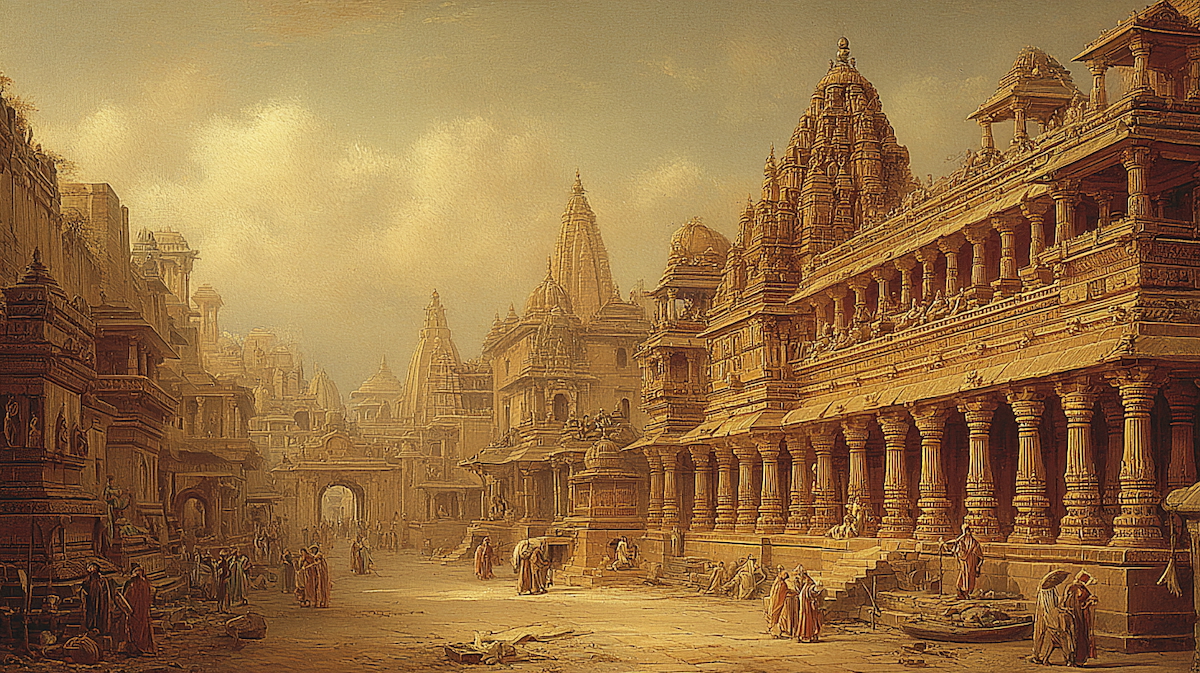
 Sandeep Balakrishna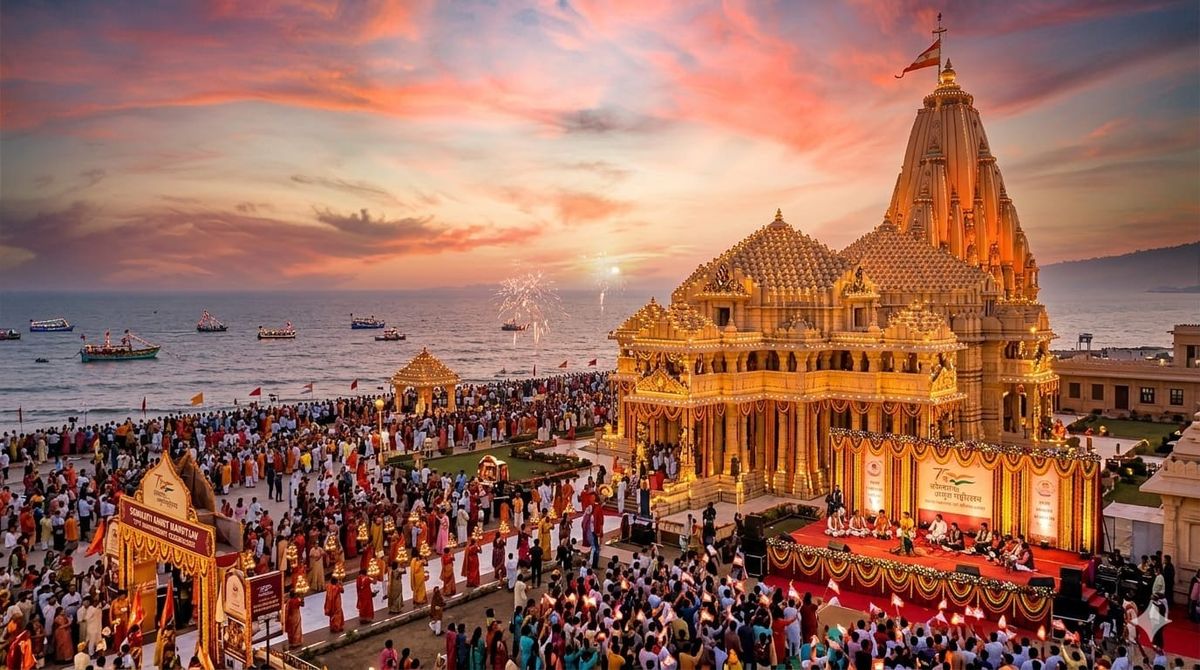
How Somanatha became the Shrine Eternal
The Bhadrakali Stone Inscription of 1169 gives an evocative firsthand account of how the hallowed Pāśupatācārya set about restoring the Somanatha Mandira. It is best to allow the inscription to narrate this story of inspired divinity.
"When the fortunate Kumarapala, who was like a Kalpa-tree in the three worlds, was constantly reigning on the beautiful and successful throne, Bhāva Bṛhaspati seeing the temple of Siva in a ruined state said to the king to repair the temple of Somanatha.
However, this was only the first major phase of rebuilding the Somanatha Devalaya. The ecstatic ceremonial celebrations mentioned in the foregoing story narrates the completion of the grand Meru-prāsāda of the temple. But Bhāva Bṛhaspati’s soaring spirit remained unslaked. This is what he did next.
He extended the town by building a strong fortress on the north and south of the Somanatha Mandira. He placed gold-pinnacles [i.e., kalasha] on the temple of Gauri, Bhimeshvara, Kapardi, Siddeshvara and other deities. He built a courtroom for the kings to assemble. For supplying water to the temple’s kitchen and for Abhisheka, he dug a Vapi [reservoir] containing the purifying waters of Sarasvati-Nadi.
He constructed a spacious Mandapa in front of the temple of Somanatha supported by ornate, strong pillars. Inside it, he erected a majestic Asana [seat] for Shiva in the shape of a frog having a water-course.
He repaired the temple of Bhagavan Pāpamocana [Vishnu] whose Vigraha was equal to the height of three men. Then he built a flight of steps leading from it to the river. To facilitate the worship and other prescribed austerities for this deity, he built very large houses for Brahmanas in the vicinity.
He also renovated the Chandika shrine in the Somanatha temple complex and renewed [i.e., made additional provisions for] her worship.
But Bhāva Bṛhaspati was still not done. He extended the city of Somanatha by establishing a “new town” and true to character, built a new Chandika temple in it. Then he dug two new Vapis in this town. The inscription extols the sterling marvels of one of them as follows:
This Vapi, which was caused to be made by Gaṇḍa, is of large dimensions, has sweet water and is named Amrita. This Vapi, whose water is being drunk by hundreds of brass-buckets, which make a pleasant rippling sound seems to laugh at the ocean though its water was drunk by the sage Agastya, born from a Kumbha (earthen water-pot).
Bhāva Bṛhaspati was the supreme beacon of inspiration and a force of divinity that transformed Somanatha the Shrine and Somanatha the sacred Kshetra into a coveted hub of pilgrimage and an exceptional centre of learning. With the unstinted patronage of Kumarapala and the consecrated succour of the people, Somanatha touched its most splendid zenith in its hallowed history. This poignant story of its spectacular resurgence has been wholly blotted out from our national memory not to mention our textbooks.
And it was this Somanatha that Ala-ud-din Khalji’s scourging army of Islam attacked, the “tongue of the Imperial sword,” thirsting for the blood of infidelity and idolatry.
|| Jai Somanatha ||
Donate to The Dharma Dispatch