

Read the Earlier Episodes in this Series
Also Read: Indian Epigraphy or an Invitation to Profundity: Where the True History of India Resides
Also Read: The Golden Age of Indian Epigraphy
— 4 —
INDIAN EPIGRAPHY IN PARTICULAR, is one of the toughest disciplines and a highly demanding profession. In no specific order, it calls for expert-level — or at any rate, a highly advanced knowledge in multiple disciplines including but not limited to mathematics, geometry, chemistry, language, linguistics, grammar, literature, poetry, art, folklore, painting, sculpture, history, geography, genealogy, dating, orthography, sacred and secular lore, history of our religions and sects, ancient and medieval jurisprudence, material history… the common metaphor, “oceanic knowledge” fits like a glove to the discipline of epigraphy.
Thus, the decipherment of every inscription typically follows this broad pattern:
- Location and date of its finding
- Condition of the inscription — whether it has been preserved intact or if damaged, the precise extent of the damage.
- An approximate date of the inscription itself in cases where the date is either illegible or unavailable.
- Dimensions and material of the inscription (copperplate, stone, palm-leaf, etc).
- Language, script and characters of the inscription — Nāgari, Brāhmī, Kannada, Tamil, etc. Here is a random example: “The characters of the inscription are a variety of the Northern alphabet which are hardly distinguishable from those of the Ganjam plates of Madhavaraja of the Gupta year 300… Its style of writing, so far as reflected in the engraving, is quite dissimilar to that of the Puri plates of Madhavavaraman. In the former, letters are formed by continuous lines, while in the latter by sharp and detached strokes. The alphabet of the Puri plates cannot therefore be regarded as quite normal, while in the characters of this record we should recognise the writing typical of Orissa in the first half of the seventh century A. D.”
- Number of lines or verses in the inscription.
- Chandas or Metres used in the inscription. If the same metre is used in multiple verses, the number of such verses is also mentioned in brackets. For example, if an inscription has forty verses in different metres, they are enumerated as follows: Sragdharā (12) Anuṣṭub (18) Vasantatilaka (10).
- Seal or insignia on the inscription — for example, Varāha (Vishnu as the Cosmic Boar), vr̥ṣabha (Bull signifying Shiva’s vehicle), etc.
- Name of the issuer — typically a king or official or chieftain. If issued by a non-royal or non-official personage, the name of the ruling king along with his dynasty is mentioned roughly along these lines: “This grant was issued by the pepper merchant named M in village V in the Vikrama Samvat Y in the regime of the Lord of the Three Worlds, Maharaja L, and ABCD are the witnesses. It is inscribed on the northern wall of temple T by the scribe named S.”
- A full summary of the contents of the inscription is described followed by a detailed exposition or commentary. This includes discussions on topics such as (i) identification of the issuer (ii) history of the ruling dynasty (iii) context in which the inscription was issued (iv) type of the inscription: royal charter, grant, gift, order, judgement, etc (v) social, political and religious condition of the period (vi) description of the geographical features and/or peculiarities of the location the inscription was found at (vii) whether the particular inscription has a precedent and/or is related to other inscriptions found in the area or elsewhere in India (viii) contextualising the inscription with updated research done on the topic by other scholars (ix) an overall assessment or a general conclusion.
- This is followed by the full text of the inscription in its original language (Sanskrit, Prakrt, Kannada, Marathi, etc) followed by a line-by-line English translation. In some epigraphic journals, the original language is followed by its transliterated version followed by the English translation. This section is either preceded or succeeded by photographs of the actual inscription itself. A sample is given below.
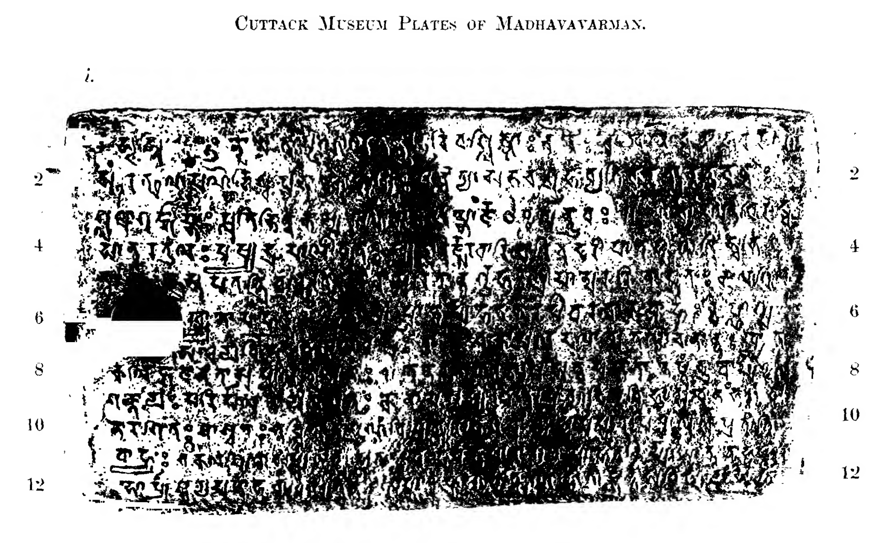
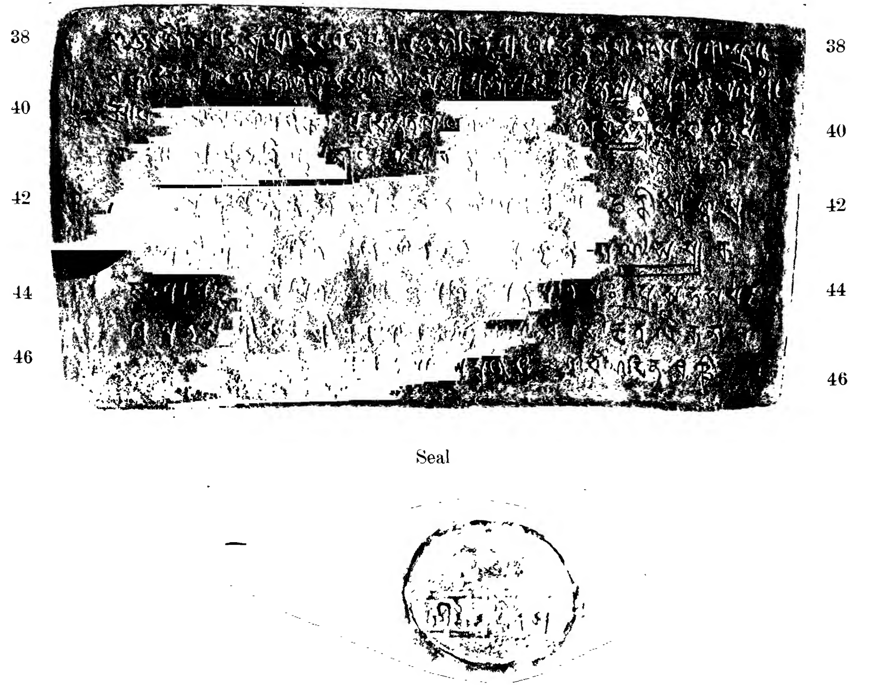
MULTIDISCIPLINARY KNOWLEDGE APART, extensive and intensive field work is both the foundational and inseparable part of epigraphy. Over the years, technology has made several aspects of field work comparatively less taxing but the physical labour involved is quite strenuous. However, the real work begins after the discovery of epigraphs, archeological artefacts, etc.
To give the briefest glimpse of the arduous nature of the endeavour, we can take the example of palm-leaf manuscripts. The following was the process from the time the manuscript was discovered, all the way up to sending it for printing. In D.V. Gundappa’s words, this was how it went:
Only those who have experienced it know how precisely exacting it is. Old palm-leaf manuscripts resemble dried firewood. They are in the danger of breaking apart the moment one touches it. They have to be separated with extraordinary delicateness, care and caution. After this begins the process of reading them. The palm-leaves must first be coated with the juice of leafy greens. It only then that the alphabets will show themselves in black strokes. This is followed by the trouble of unchaining the shackles of the Mōḍi script. This is perhaps the greatest difficulty — it is not easily understood by the people of our era [late 19th century - early or mid 20th century]. Verses written on palm-leaves are not split into neatly ordered feet [Pāda or lines in metrical poetry]. In fact, even different poems are not separated from one another. The whole inscription or poetical work is written like a single sentence from start to finish akin to a chain. Indeed, at the minimum, it takes more than half a day to read just one side of a palm-leaf manuscript... Mere scholarship is insufficient to undertake this kind of work. The person needs extraordinary levels of enthusiasm and a superhuman standards of patience.
D.V. Gundappa: (7) R. Narasimhacharya (8) M.A. Ramanuja Iyengar and Alasingacharya: D.V.G. Krutishreni Vol 6. Government of Karnataka, Bangalore, 2013
After this, the epigraphist or researcher would write down the full text of the inscription in longhand and after multiple iterations, he would prepare the fair copy and send it to the printer. This was followed by correcting the proof after which the final copy would be published.
The process of deciphering copperplate grants and stone inscriptions was even more taxing. Brilliant epigraphists like D.C. Sircar have noted in so many words that it would take them at least fifty readings of an epigraph to arrive at a reasonably accurate meaning. Once the text was published in a journal, debates over its accuracy, dating, language, etc., would continue for weeks or months, back and forth among scholars. In some cases, a scholar would suddenly come up with “New Light on Barhut Inscription No. 123” after a full decade of its first publication.
To be continued


