


Read the Previous Episode
 Sandeep Balakrishna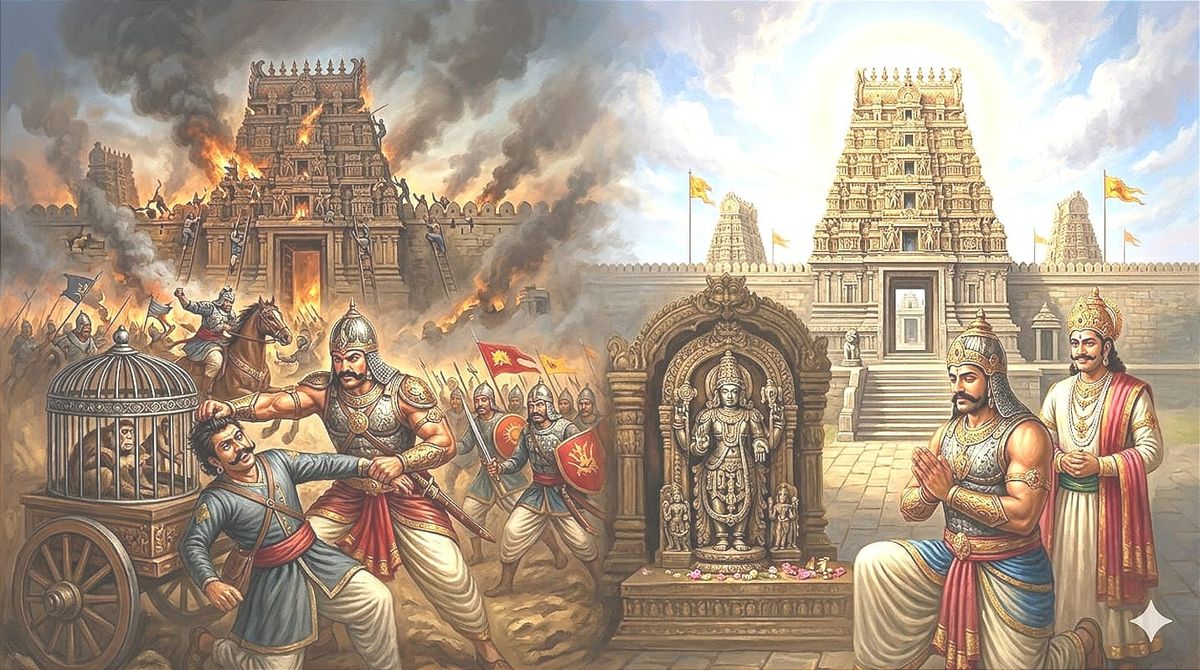
THE BELUR INSCRIPTION of 1397 CE is sadly forgotten by its own present-day inhabitants. In its significance, it is equal to, for example, the Mandasor, Mehrauli, Vidisha, Girnar, Mathura, Allahabad, Damodarapura, Junagarh, Gwalior, Nasik, Talagunda, Konark, Talakad, Aihole, Motupalli and Thanjavur inscriptions encompassing roughly a period of two millennia.
From one perspective, the Belur inscription is more significant because the episode it describes occurred in an era when Muslim political power had swallowed Uttarāpatha and had acquired a hefty foothold south of the Vindhya-Parvata; this asuric force would’ve permanently overwhelmed Dakshināpatha but for the gritty clobbering it received from the Vijayanagara Sāmrājya.
Superficially, the Belur Inscription narrates the story of the restoration and reconsecration of the Chennakeshava Temple. But its close reading unfolds a charming miniature universe of Sanatana culture, piety and a harmonious social order. This singular inscription is a lived shrine of the lofty ideals, hallowed values and profound beliefs that that society abided by.
When Gunda Dandanatha commenced the restoration work, he encountered a mass of debris; its imposing and artistic main door was an ash-heap; its massive tower had been razed to the ground and its pious art transformed into scattered stony piles; the Mūla mūrti vandalised, defaced and defiled.
Gunda remained undeterred in his sacred resolve of not merely rebuilding it but reinvigorating it on a grander scale. The royal permission that Harihara II granted was the precise fuel that powered his resolve towards fruition. Restoring the Chennakeshava Temple was also an inseparable part of a debt that the Vijayanagara Empire owed to its predecessor, the Hoysala Empire. Its greatest monarch, Vishnuvardhana (or Bittideva) was the original builder of the Temple; it was also one of the crowning glories of his forty-four-year regime. Be it a monarch, minister, commander, landlord, community or a commoner, building a temple is just the first step. Ensuring that it outlasts its builder presents the true challenge. This among others is why every temple — ancient and new — is bequeathed with generous endowments by every section of the society; at its most basic, a temple works on the invisible principle of social trust. The Chola Emperor Rajaraja I presents the most lavish example of showering almost an infinite bounty of endowments upon the celebrated Br̥hadīśvara Temple.
Vishnuvardhana was his distant proximate in this regard but matched him in piety and generosity. The Belur Inscription proves both facts when Gunda Dandanatha revived Vishnuvardhana’s endowments to the Chennakeshava Temple; the number is a grand total of fifty-six. This is a standard number prescribed in traditional temple Āgama literature; each endowment is known as Bhōga (enjoyment) offered as a Seva (service) to the deity. The widely familiar Hindi term Chappan bhōg preserves this sacred continuity of tradition.
But before listing the Bhōgas that Gunda Dandanatha revived, it is rewarding to read his statement of intent verbatim from the Belur Inscription:
Now follows the list of endowments.
- The chanting of the Vedas for the deity
- The daily worship (Nityarchana) adhering to the paths and doctrines of the sacred Pancharatra Agama scriptures across five separate shrines.
- The various ceremonial stations (Asanas) of the deity including:
- Mantrasana - Prayers
- Snanasana — Sacred bath
- Alankarasana — Adornment
- Yatrasana — Public procession
- Bhojyasana — Food offerings
- Sayyasana — Rest or sleep
- Aupacharika — The reverential offerings
- Samsparsaka — Pooja or ritual in which the deity is touched in reverence during the process of the ritual.
- Hridyangama — The pleasing and heart-warming services
- Chatusshasti Upachara — The sixty-four traditional offerings
- Shat-kala-archana — Worship performed six times a day
- Nitya-homa — Daily fire rituals
- Nityotsava — The recurring celebrations including the daily festivals
- Pakshotsava — Fortnightly festivals
- Masotsava — Monthly festivals
- Samvatsarotsava — Annual festivals
- Pavitrotsava — Purification festival
- Svapana — The ritual slumber
- Shayanotthana — Awakening the deity from sleep
- Jayanty-utsava — Birth anniversaries of various deities
- Rama-Krishna-janmotsava — Birthday celebrations of Sri Rama and Sri Krishna
- Damana flower-festival
- Kamala flower-festival
- Kalhara (white water lilly) flower festival
- Vasantotsava — Spring festival
- Dolaropana — Swing festival
- Dipotsava — The festival of lights
- Special festivals in the auspicious months of Margashirsha and Magha;
- Bhaktotsava — The festival of devotees
- Navaratna-snapana — The sacred bath using nine types of gems
- Nava-vastrabharana — The offering of fresh garments and ornaments
- Vishesha-samaradhana — special mass feasts
- Sakala-phala-vastu-darshana — The ceremonial viewing of all varieties of fruits and auspicious objects
- Maatru-darshana — Viewing of the divine Mother
- Madhu-Purana and Bija-Purana — Recitation of these two Puranas
- Chaturanga-balarchana — The symbolic worship of the four divisions of the army (chariotry, infantry, cavalry and elephantry).
- Darpana — Presentation of the mirror to the deity.
- Pushpa-Malavalokana — the formal viewing of flower garlands.
- Nritya-gita-vinoda-sthana-mantapa — Performances of dance and music in the entertainment pavilion
- Dhanya-parvata — Ceremonial offering of a large heap of grain shaped like a mountain.
- Kosha-praveshana — The ritual entry into the treasury.
- Vishuv-ayana — The sacred baths during the solstices
- Sankrama-snapana — Celebrating the zodiacal transits
- Nirajana — or Mangalarati
- Nitya-naimittika-prayashchitta — The regular and occasional expiatory rituals
- Shanti-homa — The peace-invoking sacred fire rituals.
- Samasta-parivararchana — The worship of all the attendant deities.
A world of insights emerges from this stellar inscription.
To be continued
