


Preface: Past Continuous
WHAT'S COMMON TO Barkha Dutt, Rajdeep Sardesai, Karan Thapar, Nidhi Razdan, Sreenivasan Jain, Siddharth Varadarajan, Shoma Chaudhury, Punya Prasun Bajpai, Ravish Kumar and Abhisar Sharma apart from the fact that, like engorged national warts, they continue to adorn the journalism hall of shame? It’s the same thing that’s also common to Shashi Tharoor, Ramachandra Guha, Wendy Doniger, Ellen Barry, Annie Gowen and Christophe Jaffrelot.
They are all winners of the Ramnath Goenka Excellence in Journalism Awards that debuted in 2005, a year after the Congress-led UPA government seized power.
The timing of the establishment of the Award was not a coincidence but a convenience to the New Establishment. It was also the newest entrant to a very old newspaper ecosystem that Nawab Nehru had established after 1947.
An overwhelming majority of the Ramnath Goenka Excellence in Journalism award-winners since its inception are directly or tangentially drawn from the gustatory cesspool of breaking India forces, popularly known as the Congress - Left ecosystem.
A partial list of their award-winning qualifications include graduate, postgraduate or postdoctoral degrees in sleazy political fixing, moonlighting as stenographers for shady corporate lobbyists, becoming mouthpieces in service of Krantikari (revolutionary) urban Naxal “leaders,” wiping off the stains of sexual predators in the media, schmoozing cash for votes, fudging government data in the service of the Congress party, apologising for Jihadis and Islamic separatists, acting as front organisations for the global missionary network, tax evasion, money laundering, and the most prized qualification of all – an inveterate hatred of India and its Hindu ethos.
These are the “winners” of an award named after one of the great heroes of 20th Century India; a colossus who contributed in an inimitable manner to the first and more importantly, the second Indian freedom struggle – against Indira Gandhi's Emergency.
Now, reread the brief resumes of the aforementioned scabies-infected nation-wreckers who have won this award. The conclusion is inescapable – betraying Bharatavarsha was indeed a lucrative industry, one which needed treachery as both its seed and working capital.
Patriots are reminded of the immortal Shakespearean line of how such "petty men peep about to find themselves dishonourable graves."
And so, to state that Ramnath Goenka would be writhing in his grave at this posthumous disrobing of his honour is an understatement of an understatement.
Starting sometime at the fag end of his final days, the story of the sorry fate and the splintered state of The Indian Express reads like an ongoing nightmare of The Fall of the House of Usher.
Which is good enough reason to reminisce the most spectacular and the greatest triumph of Ramnath Goenka’s life. It is also an epic chapter in the political history of independent India.
THAT WAS HOW a 74-year old Ramnath Goenka thundered in his deposition before the Shah Commission formed to inquire into the binge of excesses unleashed by the Congress during the Emergency.
But just two years before this, the same Ramnath Goenka had accepted his defeat in a letter to the retired Comptroller and Auditor General, S. Ranganathan, a member of Indira Gandhi’s trusted circle:
Seventy-two years is not quite the right age to plunge yourself headlong into a protracted and uncertain battle of wits and nerve against untrammelled tyranny that respects nothing. Not even itself. Not especially when you have so much at stake: a lifetime’s work hanging perilously on just one weak, wobbling link that separates survival from annihilation.
That weak link was The Indian Express.
Chapter 1: A Patriotic Arsenal for Pissing off Powerful People
WHEN RAMNATH GOENKA took absolute control of The Indian Express on October 26, 1936 after an acrimonious fight with its previous owner, the legendary editor and newspaperman S. Sadanand, it heralded a “bright new dawn” for the paper, in the words of T.J.S. George. Here is how George describes the unfortunate parting.
As tragic as this episode is, perhaps some things are never meant to be. Ramnath Goenka proceeded to build the Express with a heady and dramatic mix of raw and native Marwari business acumen, a deep-rooted fealty to the Dharmic values of India, a fierce patriotic spirit, a doughty readiness for a good fight, a capacity for endless hard work and remorseless ruthlessness. From its fledgling days, The Indian Express was chiseled with the following values, which Ramnath Goenka had imbibed within himself.
Perhaps the most important of Goenka’s assets was his singlemindedness. Once the Express became his, everything else was set aside…nothing was allowed to interfere with his obsessive involvement with the paper…His management had the weaknesses of a one-man operation, but the One Man proved to be an unstoppable force. [Emphasis added]
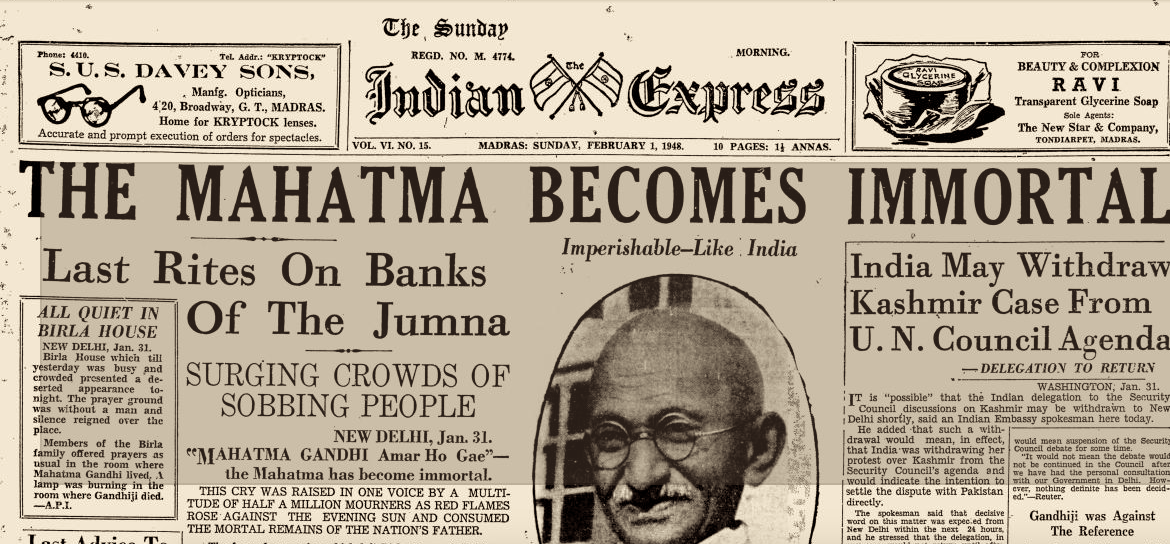
RAMNATH GOENKA threw the full might of The Indian Express behind the freedom struggle. He wantonly defied the British Government even on frivolous matters such as publishing an advertisement promoting a potion of aphrodisiac. His paper’s office at 100 Mount Road, Madras, became one of the hubs of clandestine political activity that would keep recurring even decades after India achieved independence.
When freedom fighters and nationalists of various hues decided to publish detailed reports of the British government’s atrocities during the Quit India Movement, Devdas Gandhi (Mohandas Gandhi’s youngest son and C Rajagopalachari’s son-in-law), the then editor of the Hindustan Times chickened out.
Ramnath Goenka went right ahead and published the report in the form of a scathing booklet titled India Ravaged. Government action swiftly followed. This only bolstered the paper’s credibility immensely and gave it a halo of heroism. In the eyes of the public, the Express was the resolute underdog, the unflinching fighter that didn’t cower before a vastly powerful opponent armed with unlimited power.
In less than a decade of his suzerainty, The Indian Express had acquired a cult status. He had transformed a newspaper into a patriotic arsenal.
AS LONG AS Ramnath Goenka was active, The Indian Express was wholly fashioned after his personality. I’m reminded of an anecdote that I read somewhere. Much later in his life, Goenka had to fire Arun Shourie, one of his handpicked editors. When he was asked what would happen to the Express after the firing, he apparently replied with casual nonchalance, “after all, he was also a naukar (employee) like any other.”
In hindsight, it appears that Ramnath Goenka’s favourite pastime and full-time occupation was pissing off powerful people and he finally took on the biggest of them all: Prime Minister Indira Gandhi, then at the height of her high on power.
Ironically, Ramnath Goenka was one of the people who had endorsed her candidature for Prime Minister after Lal Bahadur Shastri’s mysterious death. Goenka too, like a number of shrewd, seasoned, and battle-hardened stalwarts, had actually believed that she was a Gungi Gudiya (Dumb Doll).
He would later pay an enormous cost for this botched judgement but would also outwit her at her own game. In extremely lethal circumstances. As a result, Goenka would also emerge as one of the greatest heroes who singlehandedly challenged governmentalised tyranny led by Indira Gandhi, supervised by her Stalin-incarnate son Sanjay Gandhi and executed by his slavish band of ruffians and hitmen masquerading as cabinet ministers.
Chapter 2: The Kababs of ESlavery
PAUL VON HINDENBURG is a name that is largely forgotten in the annals of recent history. In fact, it doesn't evoke any reaction even in a majority section of the Far Left-dominated academia today.
Hindenburg was the president of the Weimar Republic who signed the fatal Enabling Act of 1933, effectively ushering in Adolf Hitler’s genocidal dictatorship for the next twelve years.
Thirty years later, Indian Prime Minister Indira Gandhi had her own Hitlerian moment when President Fakhruddin Ali Ahmed signed the equally fatal proclamation of Emergency on 25 June 1975. But her dictatorship was extremely short-lived in comparison and her excesses didn't include gas chambers but stinking prisons and forced castrations.
She had only the Hitlerian moment; her son was the actual Hitler. Both Sanjay Gandhi and Hitler were alike in their pathological lack of and total disregard for basic humanity. Both surrounded themselves with spittoon-bearers, sycophants, flatterers and lickspittles.
While the stories of the appalling horrors of the Emergency are well-known, the full saga of how absolute slavery became the most prized qualification for a career in the squalid Congress Sultanate durbar still needs to be written.
Think M.F. Hussain, the alleged painter who painted Indira Gandhi as Maa Durga riding a lion. If that painting is familiar, here’s something that is lesser-known. On the Congress annual jamboree held on December 28, 1975 in Chandigarh, this bearded, boggy, barefooted bigot exhibited his limitless capacity for dynasty bootlicking by unveiling canvases showing paintings of horses galloping past twenty posts. These represented the notorious "20-point programme" that Indira Gandhi inflicted upon India.
At the same junket, the Kuchipudi danseuse Yamini Krishnamurthy, to her everlasting shame, performed a dance piece modelled on the Ramayana, recast as Indirayana (sic). It was her toady ode to dictator Indira Gandhi.
Pull out the list of various authors, writers, actors, artists, and cultural figures who were extolled and awarded and rewarded during that period… actually, go farther back to Nawab Nehru’s era and prepare a similar list… you’ll be surprised what you’ll find.
The Emergency finally ended. Sanjay Gandhi mercifully died in 1980.
But it injected a permanent sickness on the body politic of Bharata. It institutionalised slavery and made it respectable. One of the most vomit-inducing viruses of this sickness is this quote:
That was the opening monologue delivered by Feroz Khan as a prelude to his third-rated 1980 movie, Qurbani.
Chapter 3: The Hydra-Headed Harassment of Ramnath Goenka
LUCRE IS THE OTHER SIDE OF SLAVERY.
When Lal Krishna Advani made the famous remark that the media crawled when it was merely asked to bend, little did he anticipate the sheer artistry involved in the crawling after the Emergency was lifted. The Emergency had taught an invaluable and unforgettable lesson to the media. Jumping into bed with the schmucks in the highest rungs of the Congress leadership overwhelmed the virtues of courage.
But we get ahead of ourselves.
Indira Gandhi regarded her critics as enemies, and one of her proven methods to hunt and then break them down was... harassment. Unremitting, hydra-headed harassment.
Opening your letters.
Tapping your telephone.
Unsleeping surveillance.
CBI and IT raids.
Unexplained shutdowns of electricity and water.
Stalking your family members.
Repeated midnight phone calls from strange people.
All these were merely the appetisers to nip the critic in the bud and when the critic didn't break, the main course followed and when even that failed, the dreaded dessert would descend. This was Alexander Solzhenitsyn’s proverbial midnight-knock-on-your-door. Indira Gandhi was heavily inspired by this highly effective Stalinist method.
And she served both the appetiser and the main course to Ramnath Goenka but stopped short at the midnight knock on his door because he had already anticipated it.
This riveting story reads like a fast-paced thriller, which could have had a tragic ending but didn't because this shrewd businessman and strategic warrior believed in living to fight another day by choosing a temporary retreat.
Indeed, it is difficult to fully appreciate Ramnath Goenka’s steely mettle in frontally confronting Indira and Sanjay Gandhi at the height of the Emergency without giving some details of that terror-ridden era.
IT IS BEST to let him narrate that story.
Oh, and for levying false allegations against Ramnath Goenka, Indira Gandhi deployed the services of the most eminent presstitute of that period: the despicable Russi Karanjia, editor of the seedy tabloid, Blitz. In 1972, Blitz ran a shameless smear campaign against Ramnath Goenka: a series of propaganda pieces with such titles as Goenka Golmal.
In many ways, Karanjia was the progenitor of contemporary presstitutes like Tarun Tejpal, Ravish Kumar & co. He also directly mentored other loathsomes like P. Sainath and Teesta Setalvad. For ideological and other reasons, Karanjia had earned admirers in various circles – the first name that pops up in mind is Sudheendra Kulkarni. Like peas in a pod, etc.
Ramnath Goenka continues.
In other words, it was now time for Prime Minister Indira Gandhi to tick off the next item in her sickening bucket list. The assault against Goenka was launched simultaneously on two main fronts: family and business.
The attack on Goenka’s family was the open threat of imprisoning his son B.D. Goenka and his samdhi, Shreyans Prasad Jain under the draconian MISA law – the same law which my school Civics textbook hailed as an important legislation to protect national security and promote the patriotic spirit. The threat to Goenka’s family was carried out by two hitmen. The first was the reptilian D.K. Barooah, of India is Indira. Indira is India infamy. The second was Rajni Patel, grandfather of film actress Ameesha Patel.
What Congress Usurpation Looks Like
The attack on Ramnath Goenka’s business empire, especially the Indian Express was of an entirely different magnitude. It was spearheaded by Sanjay Gandhi who unchained his private Goebbels to do the dirty work. That man’s name was Vidya Charan Shukla, a strong contender for the gold medal in knavish slavery.
Shukla was made the I&B Minister after Sanjay Gandhi footballed I.K. Gujral for refusing to obey him. Shukla’s “promotion” resembles that of a mafia foot soldier who is promoted by the Don to the rank of an Enforcer. "Goebbels" Shukla was also the censor who banned Kishore Kumar’s songs on All India Radio because he refused to sing at a rally of Mrs. Gandhi. He met his deserved comeuppance in 2013 by being blown to bits by a bomb; his gruesome death is the surest refutation of atheism. Sanjay Gandhi gave him dictatorial power to harass Ramnath Goenka.
Constraints of space forbid me from narrating the full story of the naked harassment that V.C. Shukla inflicted upon Ramnath Goenka. I refer the interested reader to Chapter VIII of The Goenka Letters by T.J.S George for an excruciating, blow-by-blow account of this Stalinist saga.
No low was too low for Shukla. Lying, deceit, reneging on promises, hooliganish tactics of intimidation… Goenka's letters reveal the full, notorious character of Shukla who took an obvious, sadistic delight in tormenting and humiliating a 72-year old freedom fighter and patriot.
The first salvo fired at Goenka came in the form of a proposal: the Congress party would buy out the Express Newspapers. But when Ramnath Goenka agreed and stated his terms and conditions, the Congress backed out for two reasons: one, the price that Goenka demanded was staggering; two, the party simply didn’t have the brains or talent to run a paper like The Indian Express.
Usurpation was the only solution. The Emergency goon squad decided to appoint Sanjay Gandhi’s cronies on the Express board of directors. The man chosen by V.C. Shukla for “negotiating” this usurpation was K.K. Birla, owner of The Hindustan Times, who enjoyed a close association with both Indira and Sanjay Gandhi. As Goenka notes,
Mr. Birla spoke on the authority Mrs. Gandhi had given him through her son and was… instructed to threaten me that the Government had the power to legislate the takeover of my newspapers.”
To his lasting credit, Ramnath Goenka refused to bend before Birla's threat. But he finally caved in when he was cornered with that ultimate weapon that all tyrants use when they run out of options: the threat of destroying Goenka's family. In his deposition before the Shah Commission, Goenka confessed:
Ramnath Goenka yielded not out of cowardice or fear but strategy. He decided to survive and fight another day. His deposition reads like a manifesto of the iron will of a 72 year-old patriot and nationalist.
The extent to which The Indian Express had mortified Indira Gandhi even during the Emergency can be gauged by the prevailing situation at the time. Most media houses had cravenly crumbled after the Emergency was declared. The most deplorable face of this surrender was self-censorship by private media houses. Their voluntary silence was one of the three pillars of that sustained the Emergency regime. The other two were Samachar (a single news agency formed by the forcible merger of PTI, UNI and Hindustan Samachar), which broadcast only “approved” news, and the POPOMA (Prevention of Publication of Objectionable Matters Act, which gives no room for ambiguity as to its intent). To cite T.J S. George again:
Even a Samachar-approved news item, meaningless otherwise, was thought of as securing a special meaning to its readers if it appeared in the Indian Express. [Emphasis added]
Chapter 4: Ramnath Goenka Checkmates Indira Gandhi
RAMNATH GOENKA's acceptance of defeat should have ideally alarmed the Congress. But V.C. Shukla who was leading the manhunt was elated; he had drawn blood at each step and now he had Goenka by the jugular; the more Goenka conceded, the more Shukla demanded.
In the new arrangement, the majority control of the Express Board meant that the Congress would have six directors and Goenka’s family would have five. What Shukla didn’t anticipate was the speed and readiness with which Goenka had acquiesced. Accordingly, the following dynasty-approved eminences would henceforth sit on the Express Board:
- K.K. Birla
- P.R. Ramakrishnan
- Vinay K. Shah
- A.K. Antony
- G.D. Kothari
- Kamal Nath
Then, Shukla floated his next demand: sack the journalist Kuldip Nayar and the editor Mulgaonkar and appoint Congress doormats in their place. One highly recommended name was that of Suman Dubey who was made the acting Editor-in-Chief. These appointments were made sometime in December 1975 - January ’76.
In March 1976, Ramnath Goenka suffered a serious heart attack.
As he lay languishing in the hospital, Mulgaonkar was sacked and V.K. Narasimhan was appointed as the Editor of The Indian Express.
When Ramnath Goenka recovered two months later, he decided to pay a private visit to V.C. Shukla. It was time to call the bluff of this Sanjay Gandhi shoeshiner. It was tense and heated meeting.
Shukla the Sarkari bully wasn’t easily cowed down by Goenka who was notorious for his fiery temper. On the contrary, he directly threatened to arrest Goenka right on the spot and throw his entire family in jail under MISA. Goenka's response stunned him:
"Do it. Do it if you’re really born to Ravi Shankar Shukla!"
Ravi Shankar Shukla, the former Chief Minister of Madhya Pradesh, had been Ramnath Goenka's close friend of many decades.
Goenka stormed out of the room. V.C. Shukla’s haughty, hot-air balloon exploded just like that. Ramnath Goenka remained unscathed. But there was more than what met the eye.
And now, Ramnath Goenka made his checkmate move.
There was a reason he had so readily accepted V.C. Shukla’s proposal to stuff the Express Board with Congress cronies. George notes how
[…]
Goenka played a bigger trump card in mid 1976 when the company annual general meeting took place. The Government nominees had been appointed to the Board only as Additional Directors. This meant that they had to be formally appointed by the shareholders of the company at the next AGM. The Government had not realised this legal requirement. Goenka had, and that was why he readily agreed to the proposal for the appointment of government directors. When the AGM met, the directors were not re-elected. In September-October 1976, Goenka formally wrote to each of the six directors about the AGM’s outcome. All six resigned. The humiliation the episode brought upon… the Government itself was enormous. Goenka returned triumphantly to the helm of his empire with full powers. [Emphases added]
It was an epic tour de force, a spectacular sucker-punch on the jaw of an unhinged tyranny at the summit of its dictatorship. Ramnath Goenka had delivered it at a time when almost every other media house had willingly amputated its tongue. He had ensured that The Indian Express, although repeatedly bludgeoned, bruised and bleeding, stood erect with its spine intact.
Now scroll up and read the first two paragraphs of this essay.
Postscript
THE OFT-REPEATED homily that democracy was saved by a few extraordinary people like Ramanath Goenka is entirely true. But this tale didn’t have a happy ending. The post-Emergency period wasn’t exactly glorious. The proof is in the career trajectories of the cast of the villains of the Emergency. Here are just three names mentioned in this essay.
A.K. Antony went on to become India’s defence minister.
Suman Dubey eventually acquired enormous power by getting himself admitted to Sonia Gandhi’s inner circle.
Kamal Nath participated in the genocide of Sikhs after Indira Gandhi’s assassination and was rewarded with lucrative portfolios in the central government. He became the 18th Chief Minister of Madhya Pradesh (2018-20).
DONATE TO THE DHARMA DISPATCH
A lot of effort goes behind the scenes to offer this labour of love and unswerving dedication to Bharatavarsha and its irreplaceable cultural heritage.


