


Read the Past Episodes
 Team Dharma Dispatch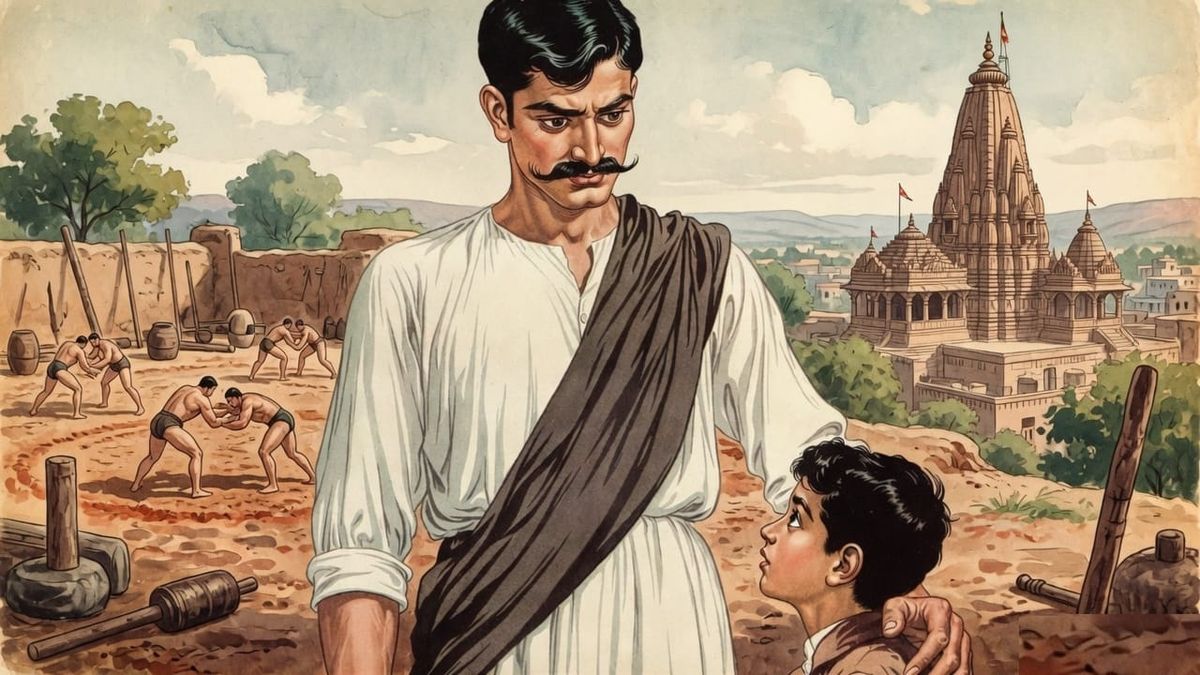
 Sandeep Balakrishna
X
A YEAR OR SO prior to the outbreak of the Indian Sepoy Mutiny, Munshi Ram was born in 1856, at Talwan, in the Jullundar district. His father—Lala Nanak Chand—a Khatri of that small village near Jullundar, was, at the time, a daroga (Sub-Inspector of Police) in the Northwest Province (now the United Provinces of Agra and Oudh). He bowed to the Lord-over-dissolution (Siva) as his god of gods and was credited with being honest. His wife was, if anything, even more devout in worshipping that deity and particularly in the adoration of his shakti (energy) now personified as Uma, the Himalayan tapesvi (anchorite), now as Durga, the white-faced, beneficent One, and now as Kali, black-visaged with blood-red, thick, long tongue lolling out of her gaping mouth and a garland of skulls depending from her neck.
Munshi Ram had begun his student career exceedingly well. Powerfully built, he assiduously cultivated his body by exercise that had not yet been displaced, to any large extent, by foreign importations. His intelligence, bright by nature, he polished with equal diligence.
Once, however, out of his mother’s sight, upon entering the college at Benares (his father was then an inspector at Bareilly), he went to pieces. Riotous living played havoc with his body and mind alike. Failure in the First in Arts examination was inevitable. Without graduation, he entered public service. High officials pleased with his father made all arrangements for him to put his foot upon the first rung of the ladder (a Naib Tehsildarship). By that means he may have climbed to executive heights: but, through his own volition, that was not to be.
XI
Illumination had come to Munshi Ram. That prospect, so bright in his fellows’ eyes, lost for him any attraction it might ever had had. No. He would go back to his studies. He would secure from the University the title that, confirmed by the Chief Court, would enable him to engage in (what was then deemed to be) an independent, honourable profession.
This light had fallen upon his mind from a Hindu sage. Named as an infant Mulshankar, he was to become illustrious. That word meant the primal shankar: and shankar was an appellation given to the lord over all the agencies that make for disintegration.
Suitably named was Mulshankar till the night of nights in his life. He then realized that the deity of his adoration was only a “stock”—a “stone.” It would vouchsafe him no solution of the problems that at the moment perplexed his votary.
That realization directed his mind towards the Veda (literally knowledge) and particularly the oldest portion of it—the Rig —and the Upanishads containing the essence of our ancient culture. With the wisdom derived from these studies, he prepared a work that he named the Satyarth Prakash—guide to the true path. According to him, this was the path that our forbears—the Aryans or Aryas (to use his term)—trod in the Golden Age.
With the scholar-teacher’s danda (staff) in hand, he—now acclaimed as the Swami Dayanand Sarasvati —travelled from town to town, province to province, everywhere preaching. Wherever he toured, he exhorted the people to come off from the tangent upon which they had flown in this degenerate age. They must get back on to the main track—the Aryan track.
His preaching threw into nervous convulsions priests who battened upon the men and (especially the) women caught in their toils. They sought to humiliate him by proving that his exposition of the writings held sacred was unwarranted. An erudite Sanskrit scholar, he, however, confounded the best of them, even at so important a religious centre as Benares—the Varanashi of the Buddha’s day and Kashi of the Kassikas.
Dayananda wandered into Bareilly (now in the United Provinces of Agra and Oudh), in 1882. Munshi Ram’s father was set by the authorities, in whose pay he was, to keep an eye over the meeting that the revivalist was to address. He took his son along, little dreaming that this was to be a red-letter day in the young man’s calendar.
Of this meeting I had an account from Munshi Ram’s own lips. The sight of the sage, he said, astonished him.
Tall and broad-shouldered, the Swami stood erect like a giant of the forest. His body was lithe as if each muscle—each tendon—was wrought of the finest steel and worked on ball-bearings. His voice, though strong and penetrating, was mellifluous. His chanting of the Vedic texts, with which his speech was interlarded, lifted the listeners from the shabby little town and deposited them in some primeval forest. There, in a clearing, the rishi, who had composed those words, was, mayhap, instructing the pupils who had entered the guru’s (teacher’s) kula (clan, sept).
The men who heard the Swami chant hymns were struck not only by the perfect intonation of the ancient words, but also by their appositeness to the theme that he was developing at the moment. They were even more impressed by the ease with which he pulverized the contentious questioner—be he Eastern or Western—Hindu, Muslim or Christian.
Moved to the depth of his soul, Munshi Ram sought and obtained the opportunity for heart to heart talks. They lifted him out of the slough in which he had been sinking.
He resolved to take the road re-discovered by the sage. His resolve shook the domestic circle. Despite the emotional storm he had raised, he stuck to his decision.
Concluded
Support The Dharma Dispatch