


Read the Past Episodes
 Sandeep Balakrishna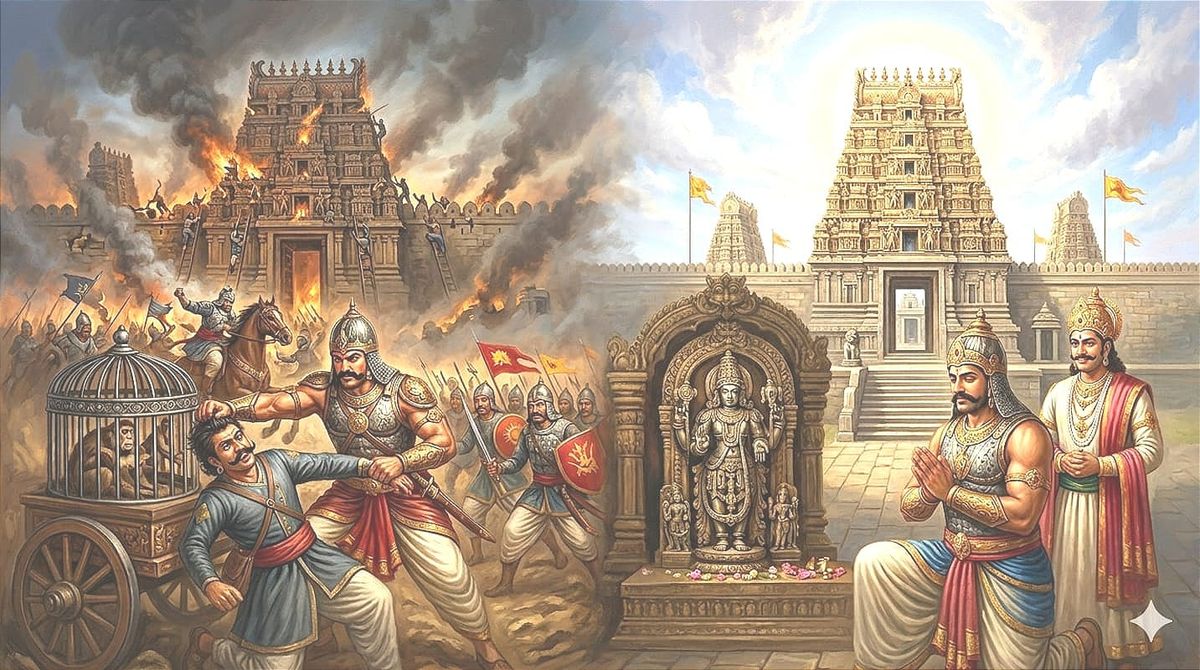
 Sandeep Balakrishna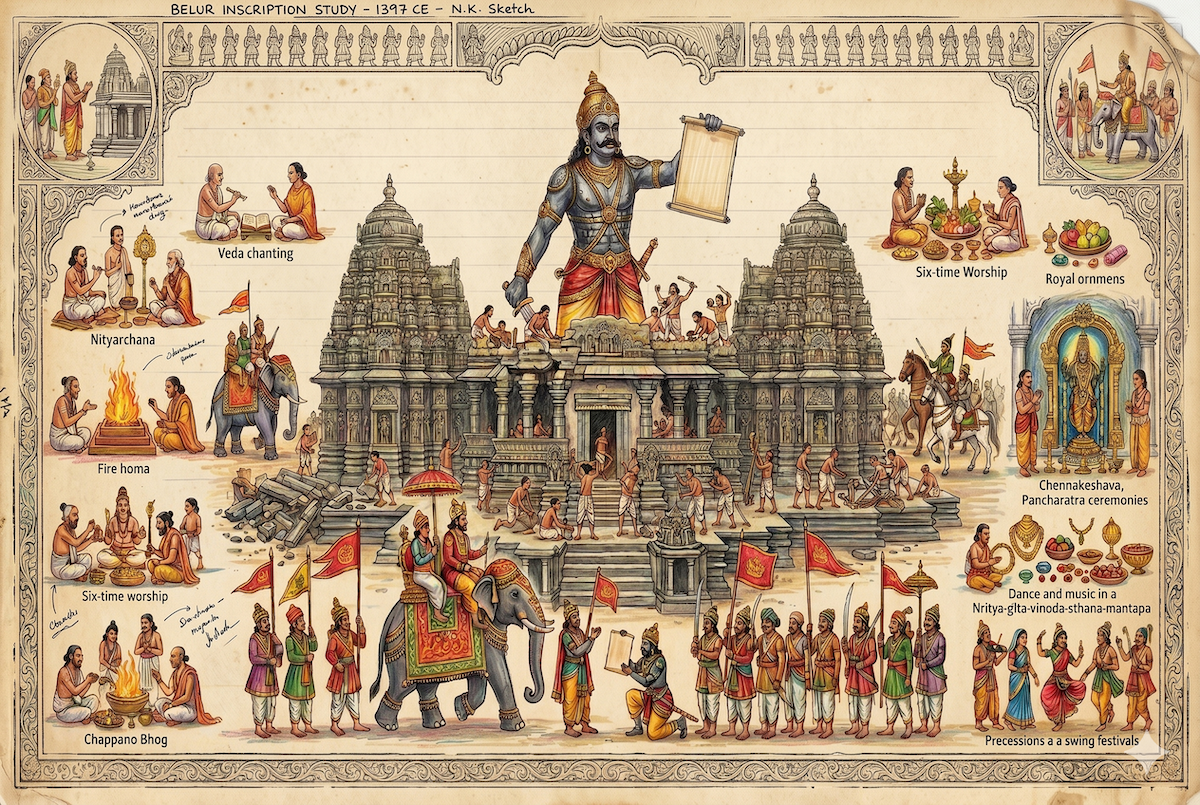
THE VIJAYANAGARA EMPIRE arose not like a phoenix but like Yajna Varāha Swami who later transformed himself into Narasimha Swami. Recorded history testifies to the harmonious and poetic justice embedded in this Puranic symbolism — Yajna Varāha was the Rāja Lān̄chana (Royal Emblem) and Narasimha Swami was the favourite Deity of several Vijayanagara monarchs including Sri Krishna Devaraya; most of the celebrated Narasimha temples in Andhra, Telangana and Karnataka were built during the Vijayanagara epoch.
Varāha Swami as the Divine Liberator of Dharitri writhing under unbearable suffering and Ugra Narasimha Swami as the ferocious guardian of the liberated Prithvi is perhaps the grandest, epic metaphor that encapsulates the Vijayanagara Story. The whole of the Hindu society joined as one body in performing this Yajna of liberation; the same society was also vigilant, ready to bare its Narasimha-like talons to rip out any Turushka threat.
The Sangama Brothers inspired and guided by Vidyaranya Swami and Sayanacharya not only liberated Dakṣiṇāpatha from Turushka clutches but rebuilt a dedicated Hindu Empire rivalling the Hoysala Empire in scale, wealth and grandeur. At its peak, it encompassed the whole region from Cuttack to Kanyakumari and Dabhol to the Malabar.
The 1397 Belur Inscription is but a representative canto of this Vijayanagara Epic.
The most pronounced insight that emerges from this inscription is the extent of prosperity that Vijayanagara enjoyed in just six decades after its founding. But in the seven decades that preceded it, the whole of Dakṣiṇapatha was in disarray after being ravaged by ceaseless Turushka raids. In his fabulous historical novel, Mallareddy, Nori Narasimha Sastry paints a grim panorama of the ground-level consequences of these raids.
The Belur Inscription appears even more remarkable when we recall that fact that its Chennakaeshava Temple was revived on this magnitude in the immediate aftermath of the Bahmani invasion. That it not only withstood it but repelled it with greater ferocity is a valourous eulogy to its enduring might. Just a century ago, Hoysala Vira Ballala III was repeatedly forced to preserve his integrity, independence and honour by grovelling under humiliating conditions imposed by Delhi sultans; the Sangama dynasty had ended that baleful era by tilting the balance in their favour.
THE RESTORATION of the Belur Chennakeshava Temple is an exemplary demonstration of where the true strength of the Hindu community lies — in uncompromising unity driven by a spiritual purpose sans any anticipation of reward. This is fundamentally a Bharatiya spirit rooted in, for example, the inimitable sacrifice of Maharshi Dadichi.
But there is a more practical, physical dimension to the Belur Inscription:
Turuka Ganga-Salaara of Kalaburagi invaded, broke and burned the gateway of the Chennakeshava Temple. In response, this temple gateway tower (gopura) was caused to be rebuilt to a height of seven storeys.
This gateway tower (gopura), the ornament of the [Belur] city, stands victorious! It bears the majestic likeness of the great mountains — Sumeru, Himavan, Malaya, and Mandara — associated with the wielder of the Śārn'ga bow (Lord Vishnu).
Its beautiful peak rises so high that it touches the celestial realm of the Gods, causing the golden anklets to slip from the lotus feet of the divine maidens (Sid'dhāṅganas) who dwell there.
The Belur Chennakeshava Temple that we marvel at today is the pious oblation offered by Gunda Dandanatha and Harihara II. Sadly, not a single ASI plaque that narrates its history mentions Gunda’s name thereby furnishing the Nth proof of the reality of secularism — the erasure of lived Hindu history. This flagrant crime is a direct violation of the intrinsic ethos of Vijayanagara, which is enshrined in a distinctive term found in thousands of its inscriptions: Pūrvada maryāde — ancient etiquette, laws, customs and manners.
The Belur Inscription perfectly reflects this ethos.
Nothing or no one compelled Gunda Dandanatha or Harihara II to restore the Chennakeshava Temple. When the Sangama Brothers founded the Vijayanagara Empire, they took a public oath to maintain the Pūrvada maryāde prevailing in every village under their control; it was also the secret sauce that fed the loyalty of the Hindu society of Dakṣiṇāpatha. Thus, the Vijayanagara Empire represents continuity, not usurpation.

TODAY, BELUR is celebrated for its ignominy as a “heritage site,” a “temple town” and the worst of all insults, as a “tourist attraction.” It was a pulsating centre of Hindu political and cultural power for centuries, first under the Hoysala and then the Vijayanagara Empire.
Even more alarming is its Muslim population breeding and inbreeding at an unstoppable pace; over the last two decades, Belur has witnessed frequent “communal” riots instigated by the followers of the religion of peace. Left unchecked, there is every possibility that it might meet a similar fate that befell it in the 1397 Bahmani invasion that wrecked its cynosure: the Chennakeshava Temple.
Back then, the steely Gunda Dandanatha was around to pound the Bahmani forces and restore the temple to an even grander majesty. Today, there is no one.
An eternal truth of politics is the fact that a king was first a warrior, ever prepared for death; we now live in an age of ministers who are “elected” not for their prowess but for drama, demagoguery and deceit.
If we were truly serious about preserving our heritage, a life-sized plaque of Gunda Dandanatha’s inscription should’ve been the first thing that greeted the pilgrim, the visitor and the tourist at the pura-dvara of Belur; it should’ve also been made a compulsory chapter in our textbooks.
I still yearn for that auspicious moment.
Series concluded