

Read the Previous Episode
 Team Dharma Dispatch
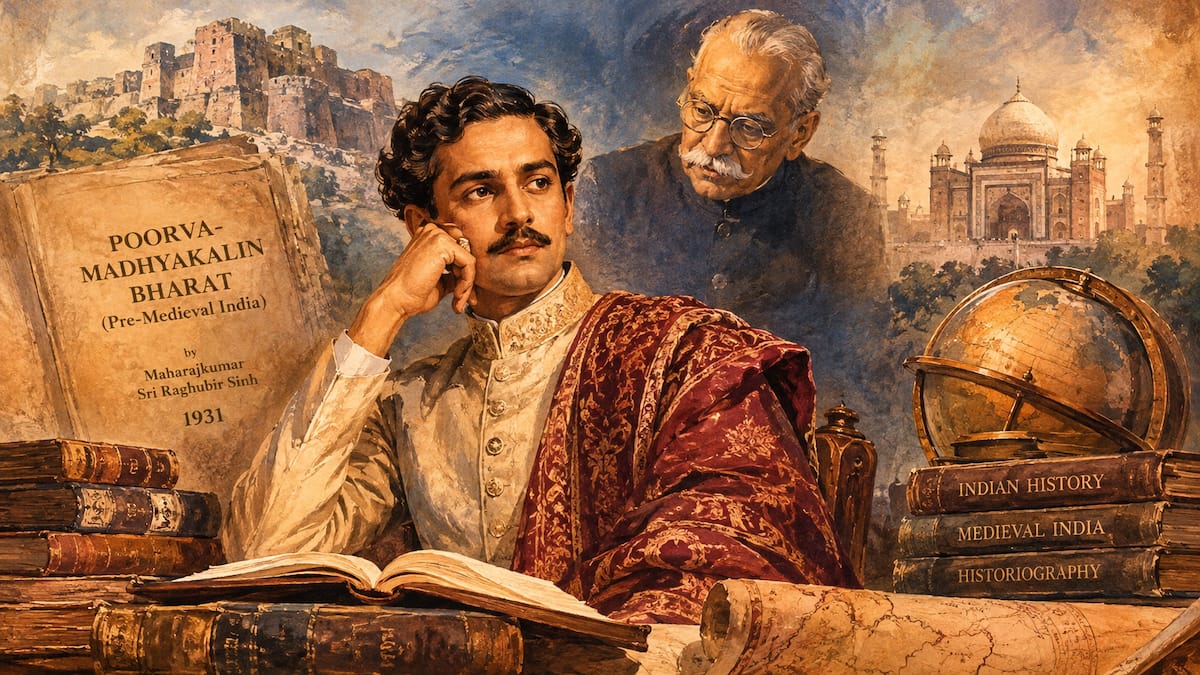
The Defects in the Style of Historical Writing
IS IT APPROPRIATE FOR US, merely because of the influence of history written in this particular (European) style, to conclude that the history of medieval India cannot be written? If the fault lies in the style of historical writing, should we then conclude that the history of medieval India is confusing and uninteresting?
If we answer these questions in the affirmative, we shall be committing a grave injustice not merely to the history of that period, but also to this nation, its inhabitants and its civilisation.
What was the condition of the Indian people during the medieval period? Very little historical material is available to acquire knowledge on this subject. Nevertheless, even from the material that is available, a considerable amount of authentic history of the country's condition can be written.
We must acknowledge that, compared with European countries, the historical material available in India is somewhat limited. However, this deficiency is found throughout the world. We cannot, therefore, blame the historians of that period for this shortcoming, because historical ideals keep changing from time to time, and the relative importance attached to different matters also rises and falls with the passage of time.
During the medieval period, not only in India but also in Europe, the rise and fall of empires, and victories and defeats in great wars, were regarded as matters of paramount importance. According to the historians of those days, describing contemporary social life and studying the rise and decline of national life were not considered particularly important.
We have already stated that the shortcomings of Indian history lie in its method of writing. On this subject, there can be no two opinions that, until now, this method of historical writing that has been followed is flawed. Before examining where the flaws lie in this style, we consider it appropriate to explain to the readers how this particular style originated.
The first modern history of the medieval period was written by Elphinstone and published in 1841 A.D. Elphinstone's history was written primarily based on the Persian texts of Firishta and Khafi Khan, and the author followed the style of those very Muslim writers. Whenever other writers subsequently took up the pen to write the history of medieval Bharat, they followed that very same style. The writing style of Part 3 of the Cambridge History of India, published a short while ago, has also been deeply influenced by Elphinstone.
The Story of the Origin of this Writing Style
Today, readers have begun to realize that historians have made two major mistakes.
First, modern writers did not take into account the changes that occur in ideals over time. They judged the character and actions of medieval emperors using modern ideals as the yardstick.
Second, Western scholars, while writing India's history, evaluated Indian emperors against Western standards. Thus, they taught our people to view our heroes with disrespect and thereby committed a great injustice to India, whether knowingly or unknowingly.
However, Indians are now gradually becoming aware of their ancient glory. They have started to feel that India's history is in no way less glorious than the contemporary history of other nations in the world.
Not only that, just as waves of religious reformation and national independence movements arose in Europe from time to time and major transformations took place in art, literature, etc., similarly, such currents have flowed in India from time to time as well. The advent of the Bhakti movement, the emergence of the Hindi language, the beginning of Hindu-Muslim art, and wars of independence are aspects that showcase India's history as even superior to European history.
This feeling of ancient greatness is now gradually percolating into Indian historians, and influenced by this, Professor Ishwari Prasad writes that "if the subject matter of history is not narrowed, it encompasses the diverse progress of society and human life, and thus medieval Indian history—with its brilliant valor demonstrated on battlefields, great acts of administration and policy, and social and religious descriptions of significant events and their changes as well."
However, changes have still not taken place in Indian historiography. According to the ancient system, history only describes emperors and their primary actions, which makes the books very uninteresting.
The Need for Appropriate Changes in Style
The diverse trends of national life and society, and the major questions that every great emperor had to ponder over to resolve, find no place in histories written in the ancient method. In Dr. Ishwari Prasad's work, a sort of amalgamation of the ancient and modern systems has taken place. He has attempted in his well-known and scholarly history to draw readers' attention at various places to the greatness of Indian history and the diverse trends of national life and society. Yet his writing style is entirely ancient. For this reason, whatever he has written on these great questions does not appear sufficient given the size of the book.
There can never be two opinions on the matter that work can no longer be carried on with historical books written in the ancient style. It is imperative that from time to time history should be rewritten. Historians should not content themselves merely with describing events.
Furthermore, merely segmenting history does not suffice. The need of the hour is to bind different historical events into distinct threads so as to create such unity through doctrinairism and generalization in history that this vast mass of events appears like a living picture.
To be continued
Donate to The Dharma Dispatch


