


Read the Past Episodes
 Sandeep Balakrishna
 Sandeep Balakrishna
 Sandeep Balakrishna
 Sandeep Balakrishna
 Sandeep Balakrishna
 Sandeep Balakrishna
 Sandeep Balakrishna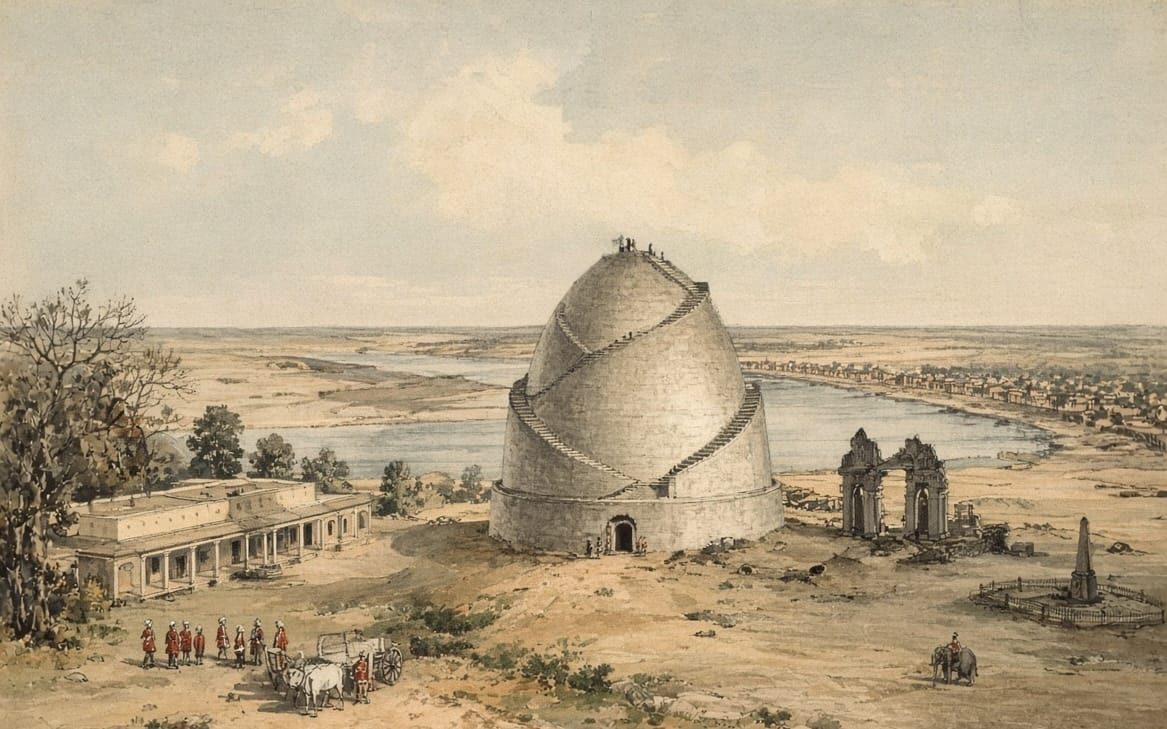
AFTER AN EARLY DINNER on March 5, 1803, Valentia resumed his onward journey and when he awoke the next morning, he found himself in a “flat but highly cultivated country.” His sight is greeted by sprawling blankets of cotton plant and the “Ricinus communis” or castor, which grew “in the greatest possible luxuriance.” The English shopkeeper’s instinct inside him awakens; he rues over the fact that “till lately, the India Company was so uninformed” that it used to send castor oil, “the medicine,” all the way from Europe whereas it grew here so abundantly.
Some distance later, Valentia spots a panoramic scene of wheat harvesting and launches into a comparative analysis.
Then he arrives at a nullah—canal, a site of the decisive Battle of Buxar (1764). He is naturally exultant at the memory of the conclusive English victory over “the united forces of Suja ul Dowlah {Shuja-ud-Daula] and Cossim Ali Khan [Mir Qasim].” It was by all means an unequal battle—a force of fifty thousand plus a large train of artillery on the Muslim side against a twelve-thousand-strong force on the British side. But it was H.H. Munro’s decisive leadership and strategy that turned the battle. In Jadunath Sarkar’s memorable verdict, the battle “ended in the Wazir’s [Shuja-ud-Daula] crushing defeat at Buxar…and in the complete prostration of Oudh at the feet of the English. The derelict Emperor [Shah Alam II], who had been incited by Shuja before the battle of Buxar and abandoned after it, took shelter with the English.”
The nullah was, according to Valentia, the watery graveyard of the Muslim forces whose “flight was so rapid, that they did not stop at Buxar, but hastened to a nullah beyond, which, being then very full, thousands were drowned in attempting to pass it.” This is the famous Toran Nullah just outside the Buxar fort and town. H.H. Munro’s dispatches to the East India Company’s Council at Calcutta gives the detailed, eyewitness account of the carnage.
The enemy’s right wing and center, unable longer to sustain the close and terrible fire of our artillery and the steady advance of our line, gave way in total confusion about twelve o’clock... Their main body fled towards the fort and the small river or nullah that runs behind it.
The Nawab [Shuja-ud-Daula] had previously constructed a bridge of boats across this stream to secure his communication and retreat… he gave immediate orders for the bridge to be cut away or destroyed, to prevent our army from pressing upon his rear.
This act proved fatal to an immense crowd of his own troops—cavalry, foot, camp-followers, and bullock-drivers—who were rushing headlong towards the passage to escape our pursuing field-pieces. Finding the bridge gone, a scene of horror and wild panic ensued. The vast mass of men, horses, and beasts of burden were forced by the pressure from behind into the deep nullah and its muddy, treacherous banks.
Thousands plunged into the stream in a desperate effort to swim across under the terror of our guns. The water became instantly choked with drowning men and struggling horses, who sank each other in their frenzy. Hundreds were suffocated in the mud or drowned in the water…
To Valentia, this was a “glorious victory” which “gave us the first connection with Oude [Awadh], which now forms so valuable a part of our possessions. The plunder was very great, as they left their tents standing; and a hundred and thirty pieces of cannon were taken.”
It was indeed a glorious victory but a victory that altered the whole geopolitics of India for the worse. Its impact was more sweeping and durable than the Battle of Palashi. The 1765 Treaty of Allahabad that ended the Battle of Buxar, put the whole of Bengal, Odisha, Bihar and Awadh in British pocket. With it, the doddering Nawab of Awadh and the so-called Mughal Emperor became pensioners of a foreign trading company.
Around twelve noon, Valentia entered the Buxar town and immeditely proceeded to the fort where he was “politely received by Colonel Stafford.”
Buxar, like all sites in Bihar, is imbued with a hoary history dating back to the Vedic Era. Its original name, Aghasara (remover of sin), was eventually transformed into Buxar. An ancient Vedic story tells us that Rishi Durvasa cursed another sage named Vedashira (Besira) who had taken the form of a tiger (Vyaaghra) to frighten him. However, the curse permanently transformed his body into a tiger’s, and to restore himself back to human form, Besira bathed in the Aghasara pond and meditated upon Gaurishankara (Shiva). Ever since, the spot was known as Vyaghrasara, which was then corrupted as Baghsar, and later, as Buxar.
The Buxar fort that Valentia saw was “of a very inconsiderable size” though it “commands the Ganges.” Originally built by Maharaja Rudra Deva—who belonged to a branch of the Paramara dynasty—in 1054, it was also the citadel that had witnessed the fierce Battle of Chausa (1539) in which Sher Shah Suri defeated Humayun and drove him out. But now, the fort presented a pathetic spectacle:
It was originally only mud; but on being taken possession of by the English, stone bastions were ingeniously added, without a proper foundation. Their weight has consequently brought them down to the bottom of the ditch. The guns are all removed, and its only use, as a fort, is to give a good salary to a Commandant. I confess I have very strong doubts of the policy of destroying these smaller places of defence, which might be kept in order at a very trifling expense, and would also serve as depots for ammunition.
Yet, despite its degraded condition, the Buxar fort served a key function—it was a commercial and military checkpost rolled into one because
Every vessel passing up or down the Ganges is obliged to come to at this place, and produce her pass; every traveller by land does the same. The police in these respects is very strict, and any irregularity would probably send back the unfortunate passenger to the place whence he came…No one can visit the upper provinces without an express permission.
And then Valentia makes a rather eye-opening revelation: “There is not at present a single fortified place between Calcutta and Allahabad, a distance of eight hundred miles.” It is thus astonishing that not a single, serious outbreak occurred after the Battle of Buxar in this extensive region for a full century—that is, till the First War of Indian Independence.
Hailing from the upper echelons of British aristocracy, Valentia didn’t need a pass to travel onwards to the “upper provinces” (the Awadh dominions). On the contrary, his “journey had been notified to the commanding officer of every station.”
That night, he had dinner with Colonel Pringle and his wife. He didn’t stay back at Buxar but “set off for Benares,” which was sixty-three miles away.
To be continued
Donate to The Dharma Dispatch


